
Mulching a Hillside: How to Calculate and Keep Mulch From Washing Away
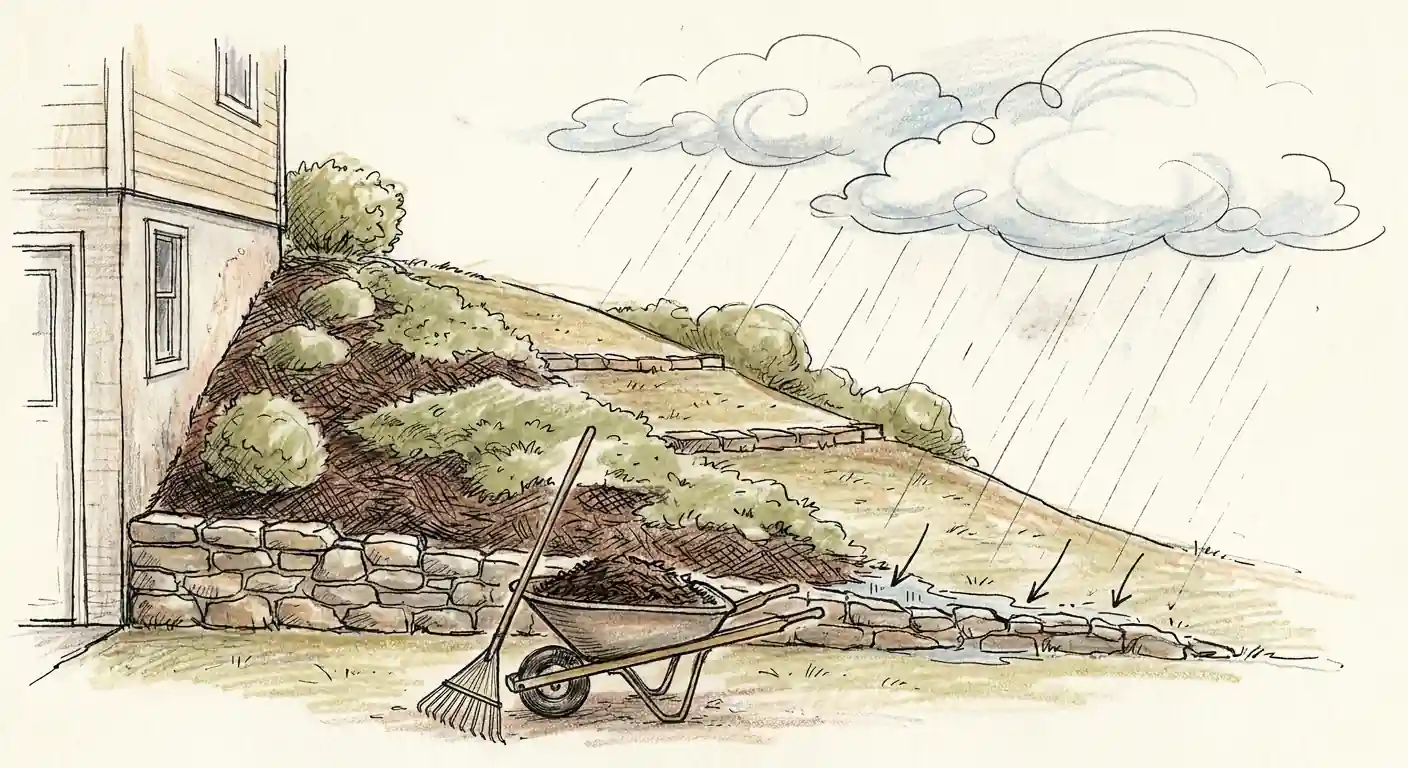
A flat bed is easy. You measure length, you measure width, you multiply, you order mulch. A hillside punishes that habit twice. First, the tape measure lies to you, because the ground you are covering is longer than the flat footprint you drew on paper. Second, gravity and rain get a vote on where your mulch ends up, and pine bark nuggets tend to vote for the sidewalk.
Why hillside mulch washes away in the first place
Mulch on a slope fails for three separate reasons, and most homeowners only fix one of them.
- Particle shape. Rounded, chunky, low-density pieces float and roll. Pine bark nuggets are the worst offender because they behave like little boats.
- Water speed. Water gains energy as it runs downhill. A short 8 foot bank and a 60 foot hill are completely different jobs even at the same angle.
- Concentrated flow. This is the hidden one. Most washouts do not come from rain falling on the bed. They come from a downspout, a driveway edge, or a lawn above the bed dumping a stream into one spot.
That last point matters because research keeps showing mulch works when it stays as a continuous cover. A global meta-analysis of mulching trials found that mulching cut runoff by about 47 percent and soil loss by about 76 percent on average, across a wide range of slopes and materials. The protection comes from unbroken contact with the soil. Once water carves one channel through your mulch, the rest of the bed unravels from that line.
Step 1: Measure the slope, not the map
A slope has a footprint and a skin. The footprint is what you would see looking straight down from a drone. The skin is the actual ground surface you have to cover, and it is always larger. You have two honest ways to get the skin measurement.
The easy way: measure along the ground
Walk a tape measure up the face of the hill, from the bottom of the bed to the top, following the ground. That distance is your true slope length. Multiply it by the width of the bed measured across the hill, and you already have true surface area. No math correction needed. This is the method I recommend for almost every home yard, because it also captures the bumps, dips, and terrace shelves that a clean triangle drawing ignores.
The precise way: use a slope factor
Sometimes you cannot walk the hill, or you only have a survey drawing with a grade on it. Then you need the slope factor, which is the same trick roofers use for pitched roofs.
Slope factor = the square root of (1 + (rise ÷ run) squared)
Measure the rise and run with a 4 foot level and a tape. Hold the level horizontally out from the hill, get it level, then measure straight down from the free end to the ground. If the level is 4 feet long and the drop is 1.3 feet, your ratio is 1.3 ÷ 4, or 0.33.
| Slope described as | Rise over run | Percent grade | Slope factor | Extra mulch vs. flat math |
|---|---|---|---|---|
| Gentle bank | 1:6 | 17% | 1.014 | +1% |
| Easy mowable slope | 1:4 | 25% | 1.031 | +3% |
| Common yard slope | 1:3 | 33% | 1.054 | +5% |
| Steep, hard to walk | 1:2 | 50% | 1.118 | +12% |
| Very steep | 1:1.5 | 67% | 1.202 | +20% |
| Near the limit for organic mulch | 1:1 | 100% | 1.414 | +41% |
Multiply your flat footprint area by the slope factor and you have true surface area.
On a typical 25 to 33 percent yard slope, the slope factor only adds 3 to 5 percent to your order. That is smaller than the waste factor you should already be adding. The slope factor stops mattering much below 25 percent, and starts mattering a lot above 50 percent. Do not let the geometry distract you from the real budget risk, which is buying the wrong mulch and paying for it twice.
Step 2: Do the volume math with a worked example
Say you have a bank behind the house. It measures 40 feet wide across the hill. Looking down from above, it covers 25 feet of horizontal run. The grade is roughly 1:3.
- Flat footprint: 40 × 25 = 1,000 sq ft
- Apply the slope factor: 1,000 × 1.054 = 1,054 sq ft of true surface
- Choose depth. On a slope, use 2 to 3 inches, not 4. Take 3 inches, which is 0.25 feet.
- Volume: 1,054 × 0.25 = 263.5 cubic feet
- Convert: 263.5 ÷ 27 = 9.76 cubic yards
- Add 8 percent for settling, spillage, and the pieces that roll to the bottom while you work: about 10.5 cubic yards
If you are buying in bags instead of bulk, the conversion trips people up fast, so check how many bags of mulch are in a yard before you load a truck. And if you are hauling mulch uphill by wheelbarrow, look at how much a yard of mulch weighs first. Wet double-shredded hardwood is heavy, and a hillside turns a routine load into real work. Plan on smaller loads and more trips.
Depth guidance for slopes only
| Situation | Depth on a slope | Why |
|---|---|---|
| Gentle bank under 25% | 3 inches | Full weed suppression, low slide risk |
| Yard slope 25% to 50% | 2 to 3 inches, in two thin passes | A deep loose layer slides as one mass |
| Steeper than 50% | 2 inches plus netting or stone | Organic mulch alone is at its limit |
| Around trees on a slope | 2 to 3 inches, flared wide, never against bark | See the tree ring mulch guide |
The two thin passes trick is worth its own line. Lay 1.5 inches, water it lightly or wait for one rain so the fibers settle and knit, then come back and lay the second 1.5 inches. A settled base grabs the top layer. One deep dump of fluffy mulch is a slab waiting to slide.
Step 3: Buy mulch that knits, not mulch that floats
This is the decision that saves or wastes your money. Rank your options by how well the individual pieces grab each other.
| Material | Holds on a slope | Notes |
|---|---|---|
| Double-shredded hardwood | Best organic choice | Long stringy fibers tangle into a mat that resists moving water |
| Single-ground hardwood, coarse | Very good | Chunkier and slower to break down, slightly less knit |
| Shredded bark, including cedar | Good | Fibrous, holds well, lighter than hardwood |
| Arborist wood chips | Fair | Heavy and cheap, but blocky pieces slide over each other |
| Pine straw | Fair to good | Needles interlock surprisingly well, but blow off in wind |
| Pine bark nuggets | Poor | Rounded and buoyant, floats and rolls in the first storm |
| Rubber mulch | Poor | Floats, migrates, and offers nothing to the soil |
| Straw or hay | Poor unless anchored | Washes and blows off, needs crimping or tackifier |
| Gravel or river rock | Excellent | The right answer above roughly 50% grade or in a drainage channel |
Field research supports the fiber logic. In a study of forest road cut slopes and fill slopes, wood chip cover reduced runoff by roughly 49 to 51 percent and sediment loss by 51 to 55 percent compared with bare soil, and outperformed sawdust and straw across every site age class.
Long-term post-fire hillslope studies point the same direction, showing that mulches which keep total ground cover above about 60 percent are the ones that keep working, and that stringy wood strand mulch stayed in place for years while lighter materials thinned out.
The practical translation for a homeowner is simple. Pick up a handful at the yard and squeeze it. If it holds together like a bird nest when you open your hand, it will hold on your hill. If it falls apart into loose chunks, it will end up at the bottom.
Step 4: Install it so the hill helps you
Material choice gets you most of the way. Installation gets you the rest.
- Roughen the soil first. Scratch the surface with a rake or hoe across the slope, not up and down. Small horizontal grooves catch fibers and slow the first sheet of water. Smooth compacted soil is a slide.
- Skip landscape fabric on steep ground. This is the most common well-intentioned mistake. Fabric creates a slick plane, and mulch surfs on it. If you want reinforcement, put biodegradable jute or coir netting over the mulch and staple it, not under it.
- Work from the top down. Spread the top of the bed first so you are not walking across finished areas and kicking mulch downhill.
- Build a toe. Stone edging, a low timber, or a shallow trench at the bottom of the bed catches whatever does move so you can rake it back instead of sweeping it off the driveway.
- Cut mini shelves. On steeper banks, carve a few small level ledges 12 to 18 inches deep across the face. Each shelf is a step where mulch can rest instead of slide.
- Fix the water above the bed. Redirect the downspout, add a small swale or berm at the top of the slope, and keep concentrated flow out of the mulch entirely. Mulch handles rain falling on it. It does not handle a garden hose of runoff.
- Plant into it. Groundcovers and deep-rooted shrubs are the permanent answer. Meta-analysis of vegetation cover shows runoff and sediment reduction climbing steadily as plant cover increases, then leveling off once cover gets dense. Mulch is the bridge that keeps soil in place until roots take over.
The 60 second Slope Stay Score
Before you order, score your hill. Give yourself points for each answer that applies.
| Question | Points |
|---|---|
| Slope is steeper than 1:2 (50%) | 3 |
| Slope run is longer than 25 feet | 2 |
| A downspout, driveway, or lawn drains into the bed | 3 |
| The bed has washed out before | 3 |
| Soil is bare with no plants established | 2 |
| Bed is sunny and dries out fast | 1 |
0 to 3 points: Double-shredded hardwood at 3 inches will hold. Standard install.
4 to 6 points: Double-shredded hardwood at 2 to 3 inches in two passes, plus edging at the toe and roughened soil. Divert any concentrated flow.
7 to 9 points: Add jute netting over the mulch, cut shelves into the face, and plant groundcover the same season.
10 or more points: Stop treating this as a mulch problem. Use stone in the flow path, terrace the bank, or get a drainage plan. Organic mulch will keep leaving until the water is managed.
The cost of getting it wrong, in real numbers
Run the same 1,054 sq ft bank two ways.
- Pine bark nuggets, 3 inches: about 10 cubic yards. Lose 40 percent to the first two storms and you are re-buying 4 yards, plus the labor of hauling it up the hill again, plus cleanup at the bottom.
- Double-shredded hardwood, 3 inches in two passes with edging: about 10.5 cubic yards, plus a few dollars of staples and netting if the score says so. You top-dress an inch next spring instead of replacing a third of the bed.
The cheaper mulch is often the more expensive bed. Mulch application rate research going back decades shows the same nonlinear pattern, where modest, well-anchored cover delivers most of the erosion reduction and adding more loose material past that point buys very little. Depth is not the lever. Cover quality and water control are.
Frequently Asked Questions (FAQs)
How steep is too steep for mulch?
Around a 1:1 grade, meaning 100 percent, organic mulch stops being a realistic answer on its own. Between 1:2 and 1:1, use fibrous mulch with netting over it and get plants established quickly. Above that, plan on stone, terracing, or engineered erosion blankets.
Do I really need the slope factor?
Only if you measured the footprint from above or from a drawing. If you ran your tape up the face of the hill, you already measured the real surface. Either way, feed the final square footage into the mulch calculator and let it handle depth and unit conversion.
Will a mulch glue or tackifier work?
Sprayed binders help on moderate slopes and typically hold for a season or two before they need a recoat. They are a good assist on top of the right mulch. They will not rescue nuggets on a steep bank.
Should mulch go on wet or dry soil?
Slightly damp is ideal. Damp fibers settle and knit together instead of sitting up fluffy. Bone-dry mulch on bone-dry soil is at its highest slide risk on day one.
How often will I need to re-mulch a slope?
A well-built hardwood layer usually needs a 1 inch top-dress every 12 to 18 months, mostly because it decomposes, not because it moves. If you are replacing volume every spring, the problem is drainage, not mulch.
Your hillside checklist
- Measure the true slope surface, by tape along the ground or footprint times slope factor
- Choose 2 to 3 inches of depth, not 4
- Calculate volume and add 8 to 10 percent for waste
- Buy double-shredded hardwood or another fibrous, interlocking mulch
- Roughen the soil across the slope before spreading
- Spread in two thin passes, top of the bed first
- Add edging or a shallow trench at the toe
- Divert downspouts and upslope runoff away from the bed
- Add netting over the mulch if your Slope Stay Score is 7 or higher
- Plant groundcover so roots eventually do the job for you
Get the measurement right, get the material right, and get the water under control. Do those three things and a hillside bed stops being an annual expense.

About the Author
Qazi Raza – Technical Creator & Researcher
Qazi Raza develops construction, engineering, and home‑improvement calculators by researching verified formulas, industry standards, and authoritative reference materials. His tools are built using data from ASTM specifications, ASHRAE guidelines, NEC tables, building codes, and widely accepted engineering textbooks. Each calculator is designed to help homeowners, DIYers, and contractors make accurate, confidence‑based decisions.