
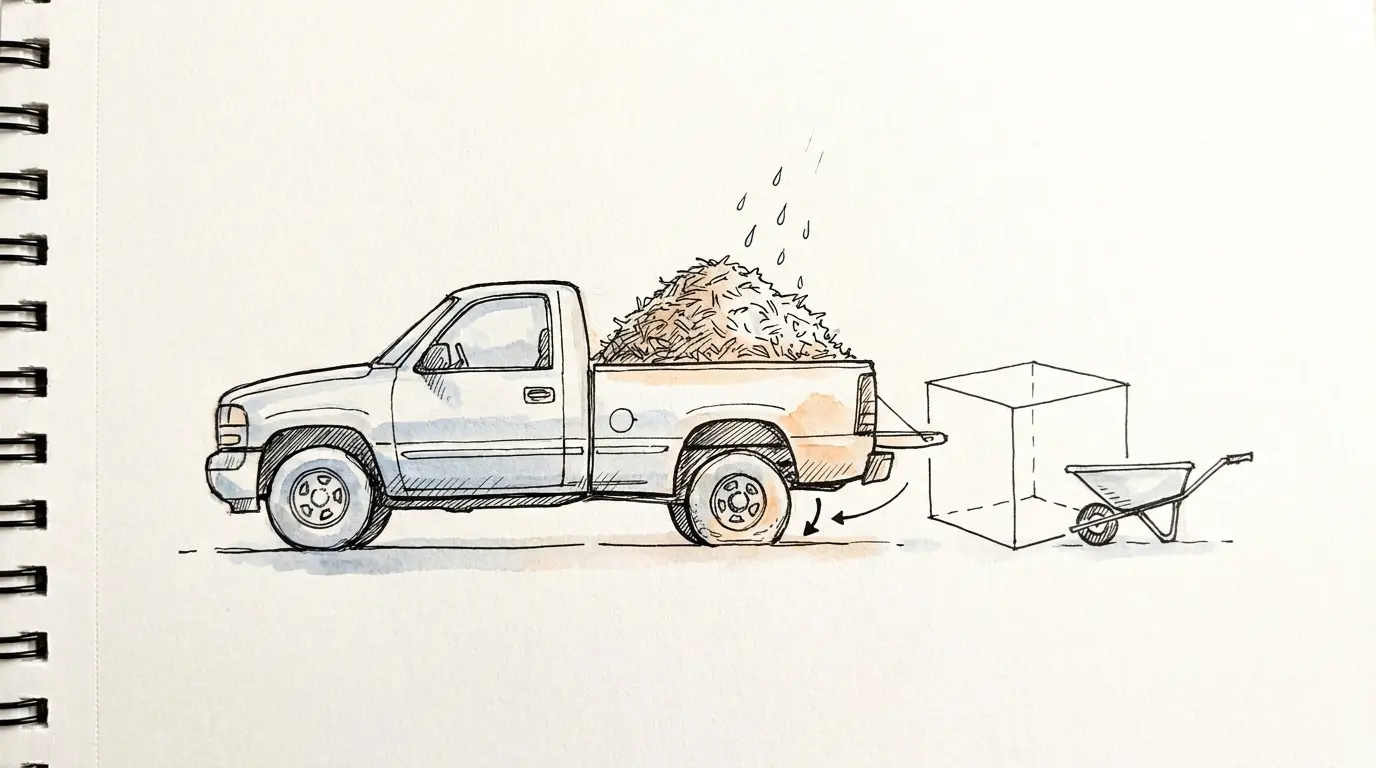
How Much Does a Yard of Mulch Weigh? (Wet vs. Dry & Vehicle Limits)
So the calculator told you that you need 3 cubic yards of mulch. Great, that part is solved. Now comes the question nobody puts on the sign at the mulch yard:
Can I actually get this home in my truck without wrecking something?
Mulch is sold by volume, but your vehicle is limited by weight. Those two numbers do not line up, and the gap between them is where bent leaf springs, blown tires, and “why is my truck pointing at the sky” moments come from.
What a Yard of Mulch Weighs
One cubic yard of wood mulch weighs roughly 400–800 lbs when dry and 800–1,200 lbs when soaked. A safe planning number for common shredded hardwood is 700 lbs dry and 1,000 lbs wet. That means 3 cubic yards is 2,100–3,000 lbs, which is more than a half-ton pickup should carry in one trip.
| Your load | Dry weight | Soaked weight | One trip in a half-ton? |
|---|---|---|---|
| 1 cubic yard | ~700 lbs | ~1,000 lbs | Yes, comfortably |
| 2 cubic yards | ~1,400 lbs | ~2,000 lbs | Only if dry, and only with a high-payload truck |
| 3 cubic yards | ~2,100 lbs | ~3,000 lbs | No. Split it or have it delivered |
If your number was different from 3 yards, re-run it on the mulch calculator and multiply your result by the pound-per-yard figure for your mulch type in the chart below.
First, What is a Yard of Mulch?
A cubic yard is a cube that measures 3 feet by 3 feet by 3 feet. That is 27 cubic feet of material. It is not a weight, a bag count, or a bucket size; it is pure volume, which is exactly why the weight can swing so wildly.
Some useful conversions to keep in your head at the garden center:
- 1 cubic yard = 27 cubic feet
- 1 cubic yard = 13.5 bags of the standard 2 cu ft bag
- 1 cubic yard = 18 bags of the smaller 1.5 cu ft “sale” bags
- 1 cubic yard ≈ 9 contractor wheelbarrow loads (3 cu ft tub)
- 1 cubic yard covers ~108 sq ft at 3 inches deep
That wheelbarrow number is the one people underestimate. Three yards is roughly 27 wheelbarrow trips from the driveway to the beds. Plan your Saturday accordingly.
Mulch Weight Chart: Dry vs. Wet, by Type
Density depends on the material. Bark is airy. Hardwood is dense. Compost holds water like a sponge. Rubber is in its own category entirely.
| Mulch type | Dry (lbs/cu yd) | Soaked (lbs/cu yd) | Plan on (lbs/cu yd) |
|---|---|---|---|
| Shredded hardwood | 600–800 | 900–1,100 | 700 |
| Double-ground / dyed hardwood | 500–800 | 800–1,100 | 650 |
| Pine bark nuggets | 400–600 | 700–900 | 500 |
| Pine bark fines | 500–700 | 800–1,000 | 600 |
| Cedar / cypress | 350–500 | 650–800 | 450 |
| Fresh arborist wood chips | 500–800 | 900–1,200 | 800 |
| Playground wood fiber (EWF) | 500–700 | 800–1,000 | 600 |
| Leaf / compost mulch | 800–1,000 | 1,200–1,400 | 900 |
| Straw | 250–400 | 800–1,400 | 350 dry only |
| Pine straw | 200–300 | 400–600 | 250 |
| Rubber mulch | 1,200–1,500 | 1,250–1,550 | 1,400 |
Rubber mulch is the trap. It barely absorbs water, so it does not get heavier in the rain but a single cubic yard already weighs about 1,400 lbs. That is close to the entire usable payload of many half-ton trucks. If you are buying rubber mulch for a play area, assume one yard per trip, maximum, and check your door sticker first.
Why Wet Mulch Weighs So Much More
This is not a small effect, and it is worth understanding because it is the single biggest variable in your haul.
Wood is porous. Dry mulch is mostly air trapped between and inside wood fibers. When it rains, water fills those voids; and water weighs 8.34 lbs per gallon. Soak a cubic yard of shredded hardwood and you can easily add 25–50 gallons of water to it. That is 200–400 extra pounds sitting in your truck bed that was not there yesterday.
The forest-products research backs this up cleanly. USDA Forest Products Laboratory density work shows that the apparent density of wood is a direct function of specific gravity and moisture content, and that above the fiber saturation point (~30% moisture), added water goes straight into the void spaces and adds mass without adding much volume.
Bulk-density studies on wood chips found bulk density shifting across a moisture range of roughly 11% to 56%; the same pile, wildly different scale readings.
Three practical consequences:
- A pile that sat uncovered through a rainy week can weigh 40–50% more than the same pile after three sunny days.
- Bulk mulch at a supplier is almost never bone dry. Outdoor piles hold moisture in the core even when the surface looks dusty.
- Bagged mulch is not automatically dry. Bags are sealed at the plant with whatever moisture the material had, and dyed mulch is often bagged wetter because of the dye carrier.
The Rain Rule (a habit worth building)
Here is a simple planning rule that has saved a lot of suspensions:
If it rained in the last 48 hours, cut your planned load by one-third. If you were going to grab 2 yards, grab 1.5. The mulch has not changed price, it has changed weight, and you are the one paying for that in axle load.
Better yet: schedule pickups for the afternoon of the second dry day. Suppliers turn and re-stack their piles, and surface material sheds a surprising amount of water in 48 hours of sun and wind.
Find Your Real Payload
The marketing number for a modern half-ton is “up to 2,400 lbs of payload!” and belongs to a stripped regular-cab 2WD work truck with a long bed and the small engine. Your crew cab 4×4 with the big screen, the sunroof, and the running boards is nowhere near that.
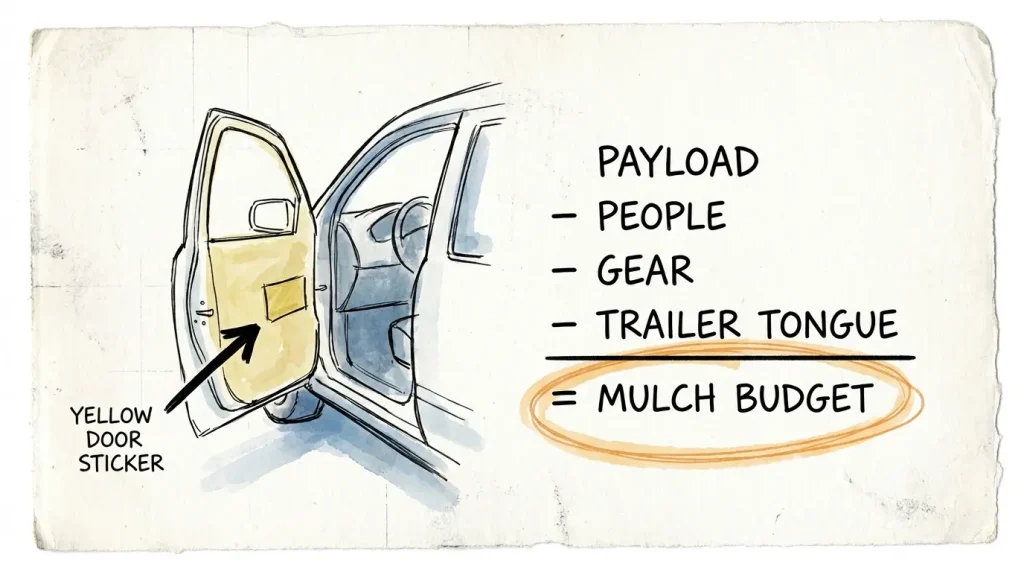
Open the driver’s door and find the yellow-and-white Tire and Loading Information label. Federal safety standards require it on the door jamb or B-pillar of every passenger vehicle sold in the U.S.
The combined weight of occupants and cargo should never exceed XXXX lbs.
That number is specific to your vehicle as it was built. It is the only payload figure worth using. Then do the subtraction:
| Line item | Example |
|---|---|
| Door sticker payload | 1,620 lbs |
| − Driver | −190 lbs |
| − Passenger | −160 lbs |
| − Tools, tarp, shovel, cooler, gas can | −120 lbs |
| − Bed liner / toolbox / aftermarket bumper | −150 lbs |
| − Trailer tongue weight (if towing) | −0 lbs |
| = Your real mulch budget | 1,000 lbs |
Then take 90% of that as your working ceiling. Not because the truck falls apart at 1,001 lbs, but because loose mulch is impossible to weigh in a driveway and yard-loader buckets are not precise. A one-scoop overshoot is common.
Real mulch budget in this example: ~900 lbs → about 1.25 yards wet, or 1.3 yards dry.
Typical door-sticker payloads (real-world, not brochure):
- Compact SUV (CR-V, RAV4): 850–1,100 lbs
- Midsize 3-row SUV (Pilot, Highlander, Explorer): 1,100–1,500 lbs
- Body-on-frame SUV (4Runner, Tahoe): 1,100–1,700 lbs
- Midsize pickup (Tacoma, Ranger, Colorado): 1,100–1,700 lbs
- Half-ton crew cab 4×4 (F-150, Silverado, Ram 1500): 1,300–2,000 lbs
- Half-ton regular cab 2WD work truck: 1,900–2,500 lbs
The Two-Number Test: Volume vs. Weight
Your vehicle has two independent limits, and whichever runs out first is your real answer.
Limit 1: Bed volume (how much fits):
| Truck bed | Approx. volume | Level-load capacity |
|---|---|---|
| Midsize pickup, 5 ft bed | ~35 cu ft | ~1.3 cu yd |
| Half-ton, 5.5 ft short bed | ~53 cu ft | ~2.0 cu yd |
| Half-ton, 6.5 ft standard bed | ~62 cu ft | ~2.3 cu yd |
| Half-ton, 8 ft long bed | ~77 cu ft | ~2.9 cu yd |
Limit 2: Payload (how much it can carry): your door sticker number, minus people and gear.
Now watch what happens with 3 yards of dry hardwood in an 8-foot-bed half-ton:
- Volume says yes. 3 yards is 81 cu ft; heaped above the rails, it fits.
- Weight says absolutely not. 3 × 700 = 2,100 lbs of mulch, plus you, plus your gear that is over the line for nearly every half-ton crew cab on the road.
The counterintuitive truth: with light, fluffy mulch you usually run out of space first but the moment mulch gets wet, or the moment you switch to compost or rubber, you run out of weight first, often with the bed only half full. Never plan a load by looking at the bed. Plan it with a calculator and a door sticker.
How Many Yards Can Your Vehicle Actually Haul?
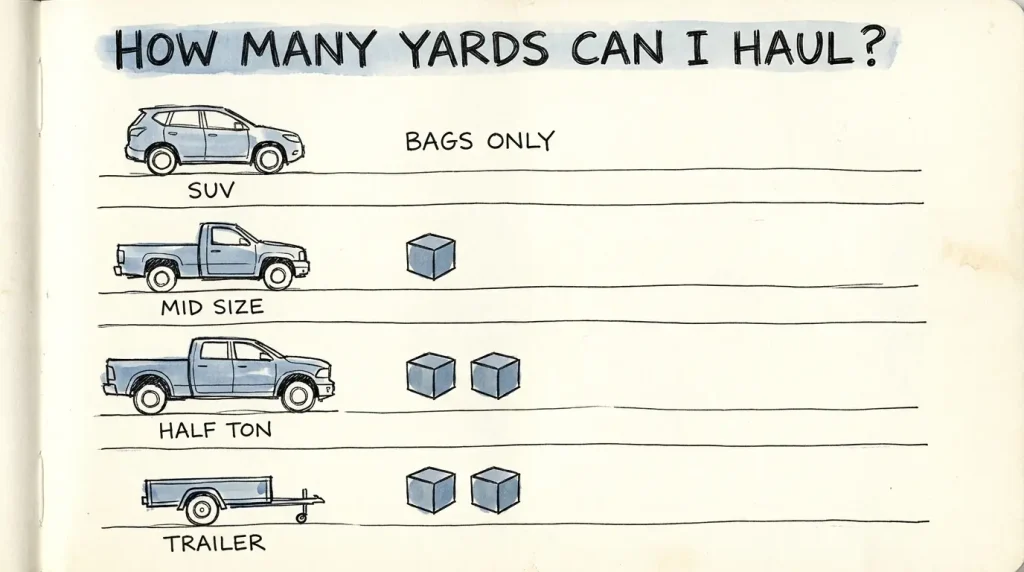
Assumes shredded hardwood, one driver, light gear:
| Vehicle | Dry mulch | Wet mulch | Trips for 3 yards |
|---|---|---|---|
| Sedan / hatchback | Bags only (6–8 bags) | Bags only (5–6) | Not realistic |
| Compact SUV | Bags only (10–12 bags) | Bags only (8–10) | 4+ trips |
| Midsize / 3-row SUV | Bags only (14–18 bags) | Bags only (10–14) | 3 trips |
| Midsize pickup | 1 to 1.5 yd | 0.75 to 1 yd | 2–3 trips |
| Half-ton pickup | 1.5 to 2 yd | 1 to 1.5 yd | 2 trips |
| 3/4-ton pickup | 2.5 to 3 yd | 2 to 2.5 yd | 1 trip |
| 5×8 single-axle utility trailer | 1.5 to 2 yd | 1.5 yd | 2 trips |
| 6×12 trailer, 3,500 lb axle | 2.5 to 3 yd | 2 to 2.5 yd | 1 trip |
So: can a half-ton haul 3 yards?
No, not safely, and not in one trip. A half-ton pickup is more than capable of two comfortable 1.5-yard runs. It is not capable of one 2,100–3,000 lb run.
Will one overloaded trip destroy the truck? Probably not instantly. But you are asking factory leaf springs, load-range tires, and brakes sized for the GVWR to work well outside their design envelope.
What you actually risk is real and cumulative: overheated brakes on the way down a hill, tire sidewall failure on hot asphalt, sagged or cracked leaf springs, blown rear shocks, and steering that goes light because the front axle has unloaded.
In many states, an overloaded and unsecured load is also a citable offense, and an at-fault crash while over GVWR is exactly the kind of detail an insurance adjuster looks for.
Trailers have their own math
A trailer does not make payload appear out of nowhere. Tongue weight, 10–15% of the loaded trailer weight, presses down on your hitch and comes straight out of your truck’s payload.
Load 2,000 lbs of mulch on a trailer and roughly 200–300 lbs of that lands on the truck. Also check the trailer’s own data plate: a common 5×8 utility trailer is rated around 1,500–2,100 lbs of payload, which is 1.5–2 yards of dry mulch and less when wet.
Loading It Right: Where the Weight Sits Matters
Even a legal load can drive badly if it is in the wrong place.
Pile it forward, against the cab, centered over or slightly ahead of the rear axle. Weight dumped behind the axle acts like a lever: it lifts the front end, unloads your steering tires, and makes the truck squirrelly at highway speed. Ask the loader operator to place the bucket at the front of the bed; most will, if you ask before they start.
A short pre-drive checklist:
- Tell the loader operator your limit in yards, out loud, before the first scoop. “One and a half, please” is a normal request.
- Load forward and centered, not against the tailgate.
- Air up the rear tires to the cold pressure listed on the door placard for a loaded vehicle. Underinflated tires under load are the #1 cause of blowouts.
- Tarp and strap it. Loose mulch blowing out at 60 mph is both a ticket and a hazard.
- Lay a cheap tarp in the bed first. Cleanup drops from 40 minutes to 5.
- Drive it home slower than you think. Leave twice your normal following distance and take ramps 5–10 mph under the posted advisory.
The 2-Inch Squat Test
Here is a field check you can do in the supplier’s lot, no scale required:
- Before loading, measure from the ground straight up to the bottom lip of the rear fender. Write it down.
- After loading, measure again.
- If the rear dropped more than about 2 inches on a half-ton, you are at or past a sensible load. More than 3 inches and you should ask them to take a scoop back out.
Also do a walk-around: if the rear tire sidewalls are visibly bulging, or the front end looks noticeably higher than normal, you are carrying too much. And if there is a CAT scale at a nearby truck stop, a certified weigh is usually under $15, cheap insurance the first time you haul.
Bags in an SUV: The Honest Version
If you are hauling bags instead of bulk, the limiting factor is usually space and mess, not weight until the bags are wet.
| Bag size | Dry weight | Rain-soaked weight |
|---|---|---|
| 1.5 cu ft | 15–25 lbs | 25–35 lbs |
| 2 cu ft (standard) | 20–30 lbs | 35–45 lbs |
| 3 cu ft | 30–45 lbs | 50–65 lbs |
A typical midsize SUV with the second row folded holds 14–18 standard bags; that is about 1 to 1.3 cubic yards and 300–550 lbs dry. Well within payload for most SUVs with one or two people aboard.
The catch: bags stacked on a pallet outdoors soak up rain through the perforations, and 18 wet bags is 700+ lbs. Add three passengers and a compact SUV is genuinely over its limit. Squeeze a bag before you load it, if water beads out, halve your count.
One more SUV-specific warning: cargo area floors have their own load rating, and folding seatbacks are not designed as load floors. Keep heavy bags low and forward against the seatback, never stacked above the window line where they can come forward in a panic stop.
For 3 cubic yards, bagged is the wrong tool. That is 41 bags of 2 cu ft mulch, three SUV trips, and typically 30–60% more money than bulk. Bulk wins decisively above about 2 yards.
Delivery vs. Trips: Run the Real Numbers
Most people compare a $65 delivery fee against $0 and stop there. That is not the real comparison.
Two round trips to a supplier 12 miles away:
- 48 miles of driving at ~$0.65/mile all-in ≈ $31
- 2.5 hours of your Saturday ≈ priceless, or $60+ if you value it at all
- Loading, tarping, unloading twice ≈ real physical work
- Risk of an overload judgment call ≈ the expensive one
One delivery:
- Flat fee, typically $50–$100 within 15 miles
- Arrives in one dump pile where you point
- Zero payload risk
Rule of thumb: at 3 cubic yards or more, delivery almost always wins on time, money, and mechanical risk. At 1–2 yards, hauling it yourself makes good sense if your door sticker agrees. Ask the supplier to place the pile on a tarp near your work area, not at the end of the driveway; it can save you a third of your wheelbarrow trips.
Quick Reference: Do the Math in 30 Seconds
- Get your volume. Run your beds through the mulch calculator to get cubic yards.
- Pick your pounds-per-yard from the chart above. Use the wet column if it rained in the last two days.
- Multiply. Yards × lbs/yd = total load weight.
- Read your door sticker. Subtract people, gear, and tongue weight.
- Divide. Real payload ÷ lbs per yard = yards per trip.
- Take 90% and round down. That is your answer.
Example: 3 yards of wet hardwood = 3,000 lbs. Truck’s real budget after driver and gear = 1,100 lbs. 1,100 ÷ 1,000 = 1.1 yards per trip → three trips, or one delivery.
Frequently Asked Questions (FAQs)
How much does 1 yard of mulch weigh?
Between 400 and 1,000 lbs for organic wood mulch. Use 700 lbs for dry shredded hardwood, 500 lbs for pine bark, and 1,000 lbs for anything soaked by recent rain. Rubber mulch is the outlier at roughly 1,400 lbs per yard.
How much does 3 yards of mulch weigh?
About 2,100 lbs dry and up to 3,000 lbs wet for shredded hardwood. That exceeds the usable payload of nearly every half-ton pickup once you add a driver, so plan on two trips or a delivery.
Can a half-ton truck carry 2 yards of mulch?
Usually yes, if the mulch is dry and your door sticker payload is 1,600 lbs or more with light passenger load. Two yards of dry hardwood is about 1,400 lbs. If it rained recently, drop to 1.5 yards.
Will hauling mulch damage my suspension?
A single modest overload rarely causes visible damage. Repeated overloading sags leaf springs, kills rear shocks, and accelerates tire and brake wear. The bigger short-term risk is a tire failure or a long stopping distance, not a broken spring.
How many bags of mulch equal a yard?
13.5 bags at 2 cubic feet each, 18 bags at 1.5 cubic feet, or 9 bags at 3 cubic feet.
Does mulch get heavier after it rains?
Yes, significantly. Wood absorbs water into its pore structure, and water weighs 8.34 lbs per gallon. A soaked cubic yard can weigh 30–50% more than the same yard after a few dry days.
How much does a scoop of mulch weigh?
Most suppliers’ loader buckets hold 1 to 2 cubic yards. Ask the operator what their scoop is rated at “one scoop” is not a standard unit, and assuming it is a single yard is a common way to end up 700 lbs over.
Is mulch heavier than topsoil?
No, and it is not close. A yard of topsoil runs 2,000–2,700 lbs and gravel runs 2,600–3,000 lbs. Mulch is one of the lightest bulk landscape materials by volume — which is exactly why people get away with 2 yards of mulch and get in trouble with 2 yards of soil.
References & Further Reading
- Specific Gravity, Moisture Content, and Density Relationship for Wood. Gen. Tech. Rep. FPL-GTR-76.
- Moisture Relations and Physical Properties of Wood. In: Wood Handbook, Gen. Tech. Rep. FPL-GTR-190, Chapter 4. USDA Forest Products Laboratory.
- USDA Forest Service. Bulk Densities of Hardwood Materials from Low- and High-Quality Stands. Forest Service Treesearch.
- Chalker-Scott, L. (2007). Impact of Mulches on Landscape Plants and the Environment — A Review. Journal of Environmental Horticulture, 25(4): 239–249.
- U.S. Department of Energy: Vehicle Weight Classes & Categories
This guide is for general planning. Always confirm your specific vehicle’s limits on the manufacturer’s door-jamb label, and follow your owner’s manual for loading and tire pressure.

About the Author
Qazi Raza – Technical Creator & Researcher
Qazi Raza develops construction, engineering, and home‑improvement calculators by researching verified formulas, industry standards, and authoritative reference materials. His tools are built using data from ASTM specifications, ASHRAE guidelines, NEC tables, building codes, and widely accepted engineering textbooks. Each calculator is designed to help homeowners, DIYers, and contractors make accurate, confidence‑based decisions.