
Rough Sawn vs. Milled Thickness (S2S, S4S & The Quarter System)
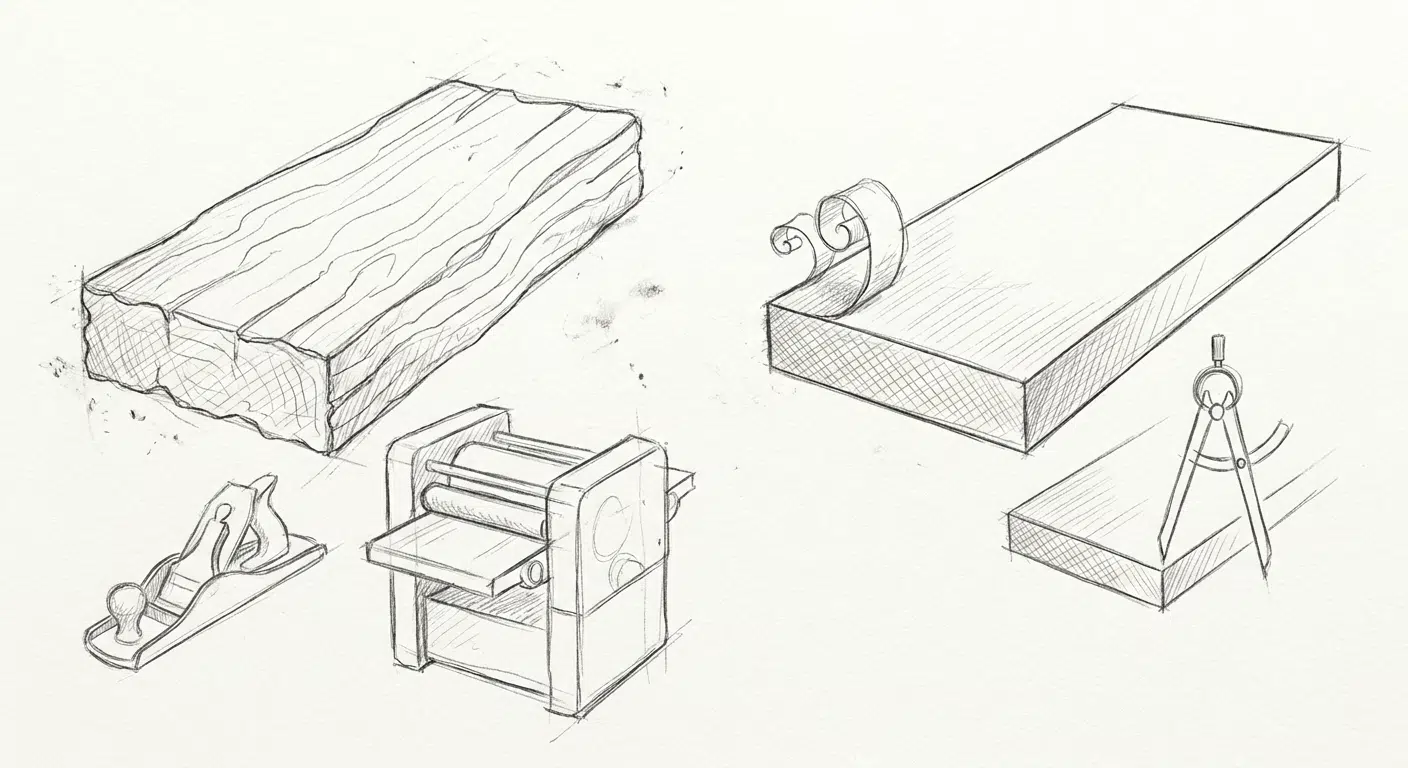
Rough sawn lumber loses thickness the moment you mill it. A 4/4 board measures about 1 inch rough, but after jointing and planing it lands near 13/16 inch at a mill and closer to 3/4 inch in a home shop. Plan on losing 1/8 to 1/4 inch, and buy the next size up when your finished thickness matters.
Why the number on the invoice is not the number in your project
Hardwood is sold rough because the sawmill cannot know what you plan to build. The faces come off the saw with ridges, the board moves while it dries, and nobody trues it up for you. Those saw marks and that movement are real material, and milling is the process of cutting them away until two faces are flat and parallel.
So the quarter system describes the lumber you pay for, not the lumber you build with. A 4/4 board is a 1 inch rough board. Your finished part is whatever survives flattening. Beginners get burned because they treat those two numbers as the same thing, then discover their 1 inch table top is only 3/4 inch thick after the planer has had its say.
The quarter system
Hardwood thickness is written in quarters of an inch. The top number counts the quarters:
- 4/4 equals four quarters, or 1 inch
- 5/4 equals 1 1/4 inch
- 6/4 equals 1 1/2 inch
- 8/4 equals 2 inch
- 10/4 equals 2 1/2 inch
- 12/4 equals 3 inch
You will hear these spoken as “four quarter” and “eight quarter,” never “four fourths.” Softwood construction lumber uses a different habit, where a 2×4 is nominal and already surfaced down to 1 1/2 by 3 1/2 inch. Hardwood keeps the rough number honest, which is why a 4/4 board really does measure about an inch when you put a caliper on it.
One wrinkle worth knowing: mills saw green lumber slightly thick on purpose, because wood shrinks across the grain as it dries. USDA Forest Products Laboratory research on moisture content and lumber shrinkage documents thickness shrinkage of roughly 2 to 3 percent as boards dry down to service moisture levels, and sawyers add a green allowance to cover it.
Sawing precision matters too, since work on sawing variation and lumber recovery shows target thickness and mechanical variation together decide how much usable wood comes out of a log. That is why one 4/4 board in the stack might mike at 1.05 inch and the next at 0.95 inch.
S2S vs S4S lumber thickness
These codes tell you how many surfaces the seller already machined.
| Code | Meaning | What you still have to do |
|---|---|---|
| RGH | Rough, straight off the saw | Joint one face, plane to thickness, joint one edge, rip the other |
| S1S | Surfaced 1 side | Flatten and thickness the remaining face |
| S2S | Surfaced 2 sides, faces planed parallel | Joint and rip both edges |
| S3S | Surfaced 2 sides plus 1 edge | Rip the last edge |
| S4S | Surfaced 4 sides, faces and edges done | Usually just a light cleanup pass |
S2S is the common stop for furniture lumber. The faces are flat and parallel, the edges are still rough, and you keep the freedom to lay out around defects before ripping. S4S looks tidy and saves bench time, but you pay for machining and you lose the ability to choose your own edges.
For hardwood dealers following NHLA grading practice, 4/4 lumber is standard surfaced to 13/16 inch, which is the single most useful number in this whole article.
S2S and S4S boards are still billed at rough thickness. If you buy 100 board feet of 4/4 S2S, you are paying for 1 inch of wood and taking home 13/16 inch. Run your numbers on the rough size with a board foot calculator so your budget matches the invoice instead of the caliper.
Rough sawn lumber thickness chart
Two finished columns here, because dealer surfacing and shop milling are not the same job. A mill planes a flat, dry, straight board with industrial equipment. You are flattening a board that may have cupped on the rack.
| Rough size | Rough thickness | Dealer surfaced (S2S) | Realistic shop milled target | Safe finished size for a flat part |
|---|---|---|---|---|
| 4/4 | 1″ | 13/16″ | 3/4″ to 13/16″ | 3/4″ |
| 5/4 | 1 1/4″ | 1 1/16″ | 1″ to 1 1/8″ | 1″ |
| 6/4 | 1 1/2″ | 1 5/16″ | 1 1/4″ to 1 3/8″ | 1 1/4″ |
| 8/4 | 2″ | 1 3/4″ | 1 5/8″ to 1 3/4″ | 1 5/8″ |
| 10/4 | 2 1/2″ | 2 1/4″ | 2 1/8″ to 2 1/4″ | 2 1/8″ |
| 12/4 | 3″ | 2 3/4″ | 2 5/8″ to 2 3/4″ | 2 5/8″ |
What is the finished thickness of 8/4 lumber? About 1 3/4 inch if a dealer surfaces it, and 1 5/8 inch is the number to design around if you are milling flat-sawn 8/4 yourself and the board has any cup or twist. Chair legs, workbench parts, and thick table aprons all live in this zone, so decide early. If your drawing says 1 3/4 inch finished and your 8/4 stock has a 1/16 inch bow, you are about to be short.
How much thickness milling really removes
Ignore blanket rules of thumb and think in terms of a stack of small losses.
- Flattening the first face. Jointing removes enough material to touch the lowest point of the high face. A board with 1/32 inch of cup across 6 inch of width loses about 1/32 inch. A board with 1/8 inch of cup loses 1/8 inch, and wider boards cup more because tangential shrinkage drives the curve. Reviews of free drying shrinkage in wood explain why that tangential direction moves the most, which is exactly the direction across a flat-sawn face.
- Planing the second face parallel. You now remove whatever it takes to clear the saw marks on the opposite face, usually 1/32 to 1/16 inch on dry, well-sawn stock.
- Cleanup for machine marks. Planers leave faint scallops and sometimes tearout. Surface roughness studies, including FPL work on planed and sanded wood surfaces, show measurable roughness remains after machining, and it varies by species and cutting conditions. Budget 1/64 to 1/32 inch for a final light pass or sanding.
- Movement between milling and assembly. Freshly milled wood relieves stress and re-equilibrates with your shop air. The Wood Handbook chapter on moisture content and dimensional change is the reference for why a board keeps moving until it reaches equilibrium with the room. If you mill today and glue up next week, leave a little extra.
Add those up and the honest range is 1/8 inch on a clean, flat, acclimated 4/4 board and 1/4 inch or more on anything cupped, twisted, or recently delivered.
The subtraction stack: pick your rough size before you buy
Work backward from the part, not forward from the invoice. Write it out once and you will stop guessing at the lumber rack.
Finished thickness you need
- first face flattening (measure the actual cup)
- second face cleanup (1/32″ to 1/16″)
- final pass / sanding (1/64″ to 1/32″)
- movement insurance (1/32″ if milling days ahead)
= minimum rough thickness to buy
Worked example 1: a 1 inch thick table top. You need 1 inch finished. Your 5/4 boards are 8 inch wide with about 1/16 inch of cup. Stack it up: 1 inch plus 1/16 plus 1/16 plus 1/32 plus 1/32 equals roughly 1 3/16 inch. A 5/4 board at 1 1/4 inch clears it with a hair to spare, so 5/4 is the right buy. Order 4/4 and you top out near 3/4 inch.
Worked example 2: 1 1/2 inch chair legs. You need 1 1/2 inch finished on all four faces, so edge jointing costs you too. 8/4 at 2 inch rough leaves about 1/2 inch of margin, which is comfortable even with twist. 6/4 at 1 1/2 inch rough leaves zero margin and will fail.
Worked example 3: 3/4 inch drawer sides. Standard 4/4 works, but if you want a true 3/4 inch with no surprises, buying 4/4 S2S at 13/16 inch gives you a flat starting point and only 1/16 inch left to remove.
Cupping budget by board width
The single biggest variable in milling loss is how wide the board is, because cup grows with width. A quick field guide for kiln dried flat-sawn hardwood that has been stickered and stored well:
| Board width | Typical cup you will see | Extra thickness to budget |
|---|---|---|
| Up to 5″ | 1/64″ to 1/32″ | 1/32″ |
| 6″ to 8″ | 1/32″ to 1/16″ | 1/16″ |
| 9″ to 11″ | 1/16″ to 3/32″ | 3/32″ |
| 12″ and wider | 1/8″ or more | 1/8″ plus |
There is a trick hiding in that table. If you rip a cupped 10 inch board into two 5 inch pieces before jointing, each piece carries half the curve, so you remove far less material and keep more thickness. You give up a glue line and gain thickness.
On a thick table top where every 1/32 inch counts, that trade is often worth it. Quartersawn and riftsawn stock cups less in the first place, which is why it mills to thickness more predictably than flat sawn.
Two-stage milling, the habit that saves projects
Professional shops rarely mill to final thickness in one session. The sequence looks like this:
- Rough cut parts slightly oversize in length and width.
- Mill to about 1/32 inch over your target thickness.
- Sticker the parts with air on all sides and wait one to three days.
- Take the last 1/32 inch off right before joinery.
That pause lets internal stress and moisture settle, so the piece that moves does so before it is final. It costs you a day and it is the difference between parts that stay flat and parts that need a second rescue. Plan the extra 1/32 inch into the subtraction stack from the start.
Mistakes that cost thickness
- Treating 4/4 as 1 inch of usable wood. It is 1 inch of purchased wood.
- Buying S4S to save time, then needing full thickness. Surfaced stock is already thinner and gives you nothing to work with.
- Milling the day the lumber arrives. Give it a week in your shop first, especially moving between a cold truck and a heated space.
- Planing both faces evenly on a cupped board. Flatten one reference face completely, then plane the second to match it. Alternating passes chases the curve and eats thickness.
- Designing in exact fractions. If the drawing can live with 3/4 inch instead of a hard 1 inch, you save a whole thickness class and real money.
- Forgetting edges in the math. S4S parts and legs lose width and thickness, so apply the stack in both directions.
Frequently Asked Questions (FAQs)
Does rough sawn lumber vary in thickness?
Yes. Sawing variation and drying shrinkage mean boards in one stack can differ by 1/16 inch or more. Measure the thinnest board in your pile and design around that one.
Is S2S or rough better to buy?
Rough gives maximum thickness and lets you choose your own faces, and it is the right call when finished thickness is tight. S2S is better when you lack a jointer or planer, or when 13/16 inch is already enough.
Why am I billed for the thickness I planed away?
Because hardwood is priced on rough volume, which is also how board footage is tallied. Run the rough dimensions through a board foot calculator before you commit to the order.
Technical Basis
Thickness figures here follow NHLA hardwood surfacing standards, where 4/4 is standard surfaced to 13/16 inch. Milling allowances combine USDA Forest Products Laboratory data on drying shrinkage and sawing variation, published surface roughness measurements for planed wood, and equilibrium moisture content behavior described in the Wood Handbook. Shop ranges reflect common bench practice.
Disclaimer
All thicknesses are typical ranges, not guarantees. Actual milling loss depends on species, grain orientation, moisture content, board width, storage conditions, machine setup, and operator technique. Measure every board with a caliper before you cut, confirm surfacing with your supplier, and treat these charts as planning guidance rather than exact specifications.

About the Author
Qazi Raza – Technical Creator & Researcher
Qazi Raza develops construction, engineering, and home‑improvement calculators by researching verified formulas, industry standards, and authoritative reference materials. His tools are built using data from ASTM specifications, ASHRAE guidelines, NEC tables, building codes, and widely accepted engineering textbooks. Each calculator is designed to help homeowners, DIYers, and contractors make accurate, confidence‑based decisions.