
How Many Bags of Mulch in a Yard? (Full Chart + Cost Math)
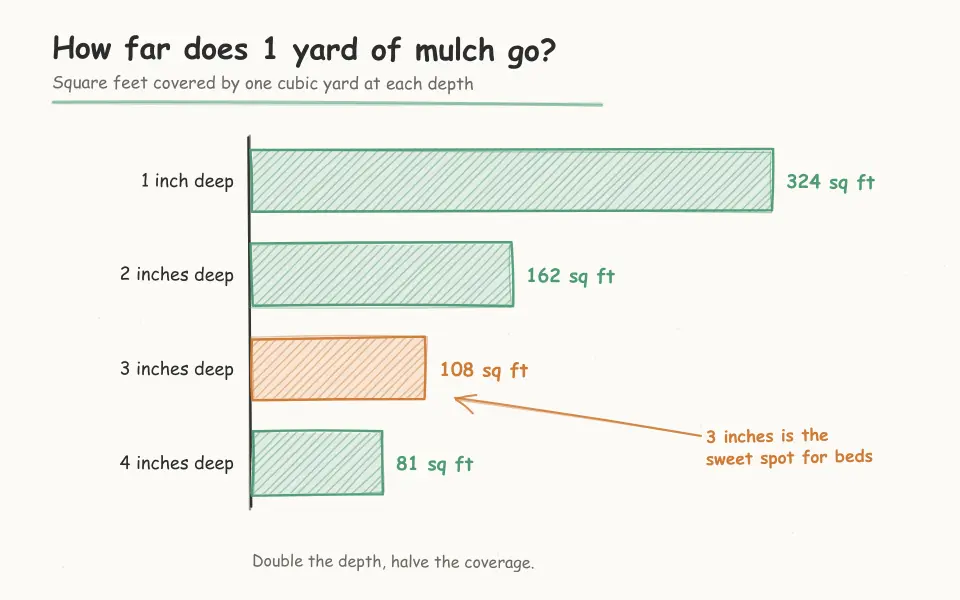
One cubic yard of mulch = 27 cubic feet. So a yard equals 13.5 bags of 2 cu ft mulch, 18 bags of 1.5 cu ft mulch, or 9 bags of 3 cu ft mulch. One yard covers about 108 square feet at 3 inches deep.
Math behind bags and yards
A cubic yard is a cube that measures 3 feet on every side:
3 ft × 3 ft × 3 ft = 27 cubic feet
Mulch bags are labeled in cubic feet, so to find bags per yard you just divide:
27 ÷ bag size (cu ft) = bags per cubic yard
Bags of mulch in a yard: full chart
| Bag size | Bags per cubic yard | Notes |
|---|---|---|
| 1 cu ft | 27 bags | Common for rubber mulch and specialty blends |
| 1.5 cu ft | 18 bags | Very common for bark, cedar, and cypress |
| 2 cu ft | 13.5 bags (buy 14) | The most common size in big-box stores |
| 2.5 cu ft | 10.8 bags (buy 11) | Occasional pine bark size |
| 3 cu ft | 9 bags | Common for pine straw bales and lighter bark |
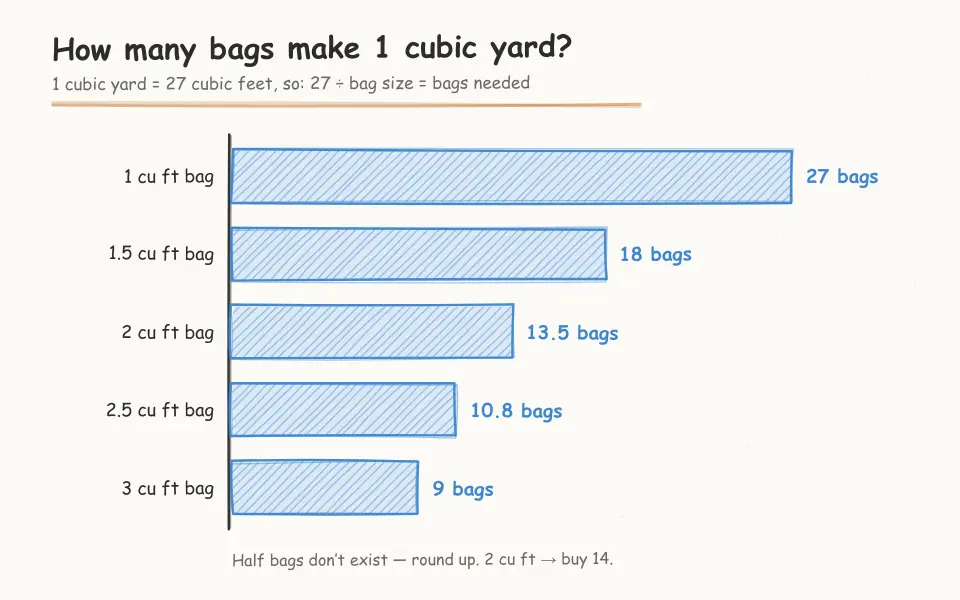
How many 2 cubic feet bags of mulch in a yard? 13.5, you can’t buy half a bag, so plan on 14 if you want full coverage.
How many 1.5 cubic feet bags of mulch in a yard? Exactly 18. This is the cleanest conversion of the bunch, which is one reason 1.5 cu ft is such a popular size.
Bags needed for 1 to 10 yards
| Cubic yards | 1.5 cu ft bags | 2 cu ft bags | 3 cu ft bags |
|---|---|---|---|
| 0.5 | 9 | 7 | 5 |
| 1 | 18 | 14 | 9 |
| 2 | 36 | 27 | 18 |
| 3 | 54 | 41 | 27 |
| 4 | 72 | 54 | 36 |
| 5 | 90 | 68 | 45 |
| 10 | 180 | 135 | 90 |
Numbers are rounded up to whole bags.
How much area does a yard of mulch cover?
Bags per yard is only half the answer. What you really want to know is how far it goes. Coverage depends entirely on depth.
| Depth | 1 cubic yard covers | One 2 cu ft bag covers | One 1.5 cu ft bag covers |
|---|---|---|---|
| 1 inch | 324 sq ft | 24 sq ft | 18 sq ft |
| 2 inches | 162 sq ft | 12 sq ft | 9 sq ft |
| 3 inches | 108 sq ft | 8 sq ft | 6 sq ft |
| 4 inches | 81 sq ft | 6 sq ft | 4.5 sq ft |
Which depth should you use?
- 1–2 inches: topping off beds that already have mulch, or around shallow-rooted plants like azaleas and annuals.
- 3 inches: the sweet spot for most beds. Deep enough to block weeds and hold moisture, shallow enough to let water and air through.
- 4 inches: pathways, playground areas, or brand-new beds with bare soil and heavy weed pressure.
Go much past 4 inches and mulch starts working against you, it can repel light rain, suffocate roots, and turn into a hiding spot for voles.
What the research says about depth: weed suppression improves as mulch gets deeper, and university trials show organic mulches approaching 4 inches can suppress nearly all common annual weeds (UC ANR).
Past that point the trade-offs take over: a 2025 systematic review of the mulch-depth literature found repeated reports of poor tree growth, girdling roots, and decay tied to excessive depth and to mulch piled against the trunk (Martin et al.). That’s why 2–4 inches, pulled back from trunks, is the range extension horticulturists recommend.
Figure out your own number in 4 steps
- Measure your beds. Length × width in feet gives square footage. For curved beds, break the shape into rough rectangles and circles and add them up (circle area = 3.14 × radius × radius).
- Pick your depth in feet. 1 inch = 0.083 ft, 2 inches = 0.167 ft, 3 inches = 0.25 ft, 4 inches = 0.33 ft.
- Multiply for cubic feet. Square feet × depth in feet = cubic feet needed.
- Convert. Divide cubic feet by 27 for yards, or by your bag size for bag count.
Worked example: A 20 ft × 6 ft bed = 120 sq ft. At 3 inches deep: 120 × 0.25 = 30 cubic feet. That’s 30 ÷ 27 = 1.1 cubic yards, or 15 bags of 2 cu ft, or 20 bags of 1.5 cu ft.
If you’d rather skip the arithmetic on an oddly shaped bed, plug your measurements into a mulch calculator and check the result against the charts above; they should agree within a bag or two.
Field shortcut worth memorizing: at 3 inches deep, one 2 cu ft bag covers roughly a 3 ft × 3 ft square. Walk your bed and count how many 3-foot squares you’d need; that’s your bag count, no calculator required.
Bags vs. bulk: the break-even formula
Typical pricing (varies by region and mulch type):
- Bagged mulch: $4–$7 per 2 cu ft bag → about $54–$95 per yard equivalent
- Bulk mulch: $30–$60 per yard, plus a $50–$100 delivery fee
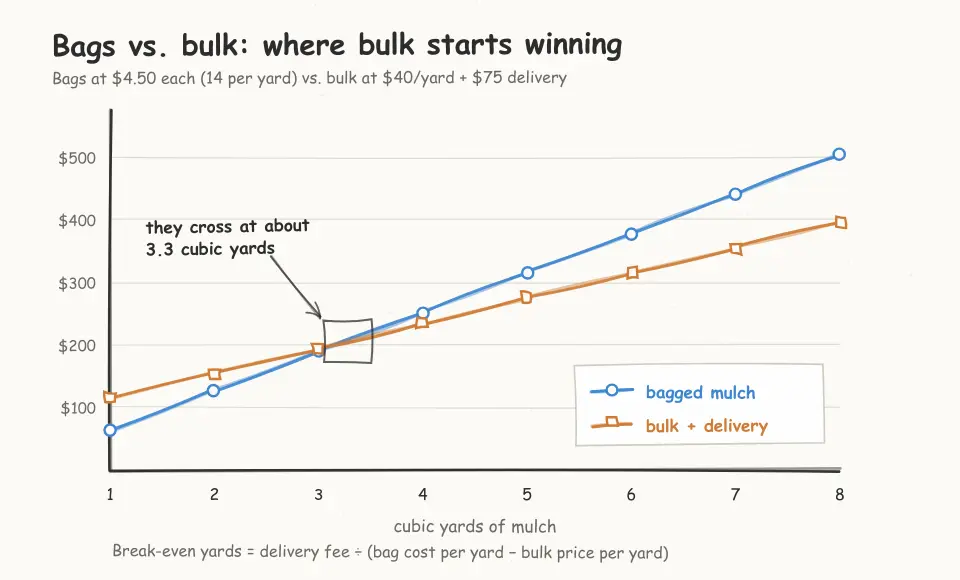
Break-even yards = delivery fee ÷ (your cost of bags per yard − bulk price per yard)
Say bags cost $4.50 each (14 bags = $63 per yard), bulk is $40 a yard, and delivery is $75:
75 ÷ (63 − 40) = 3.3 yards
So below roughly 3 yards, bags win. Above it, bulk wins and the gap widens fast. At 10 yards you’d spend about $630 on bags versus $475 delivered in bulk.
Bags still make sense when:
- You need 3 yards or less (about 40 bags or fewer).
- You have nowhere to dump a pile; no driveway space, HOA rules, or a shared parking lot.
- You want to spread the job over several weekends. Bagged mulch stores fine; a bulk pile starts breaking down, growing fungus, and heating up.
- You need a very specific color or blend that only comes bagged.
- You can catch a sale. Spring “5 for $10” bag promotions routinely beat bulk pricing even at large volumes.
Bulk makes sense when: you need 4+ yards, you have a driveway and a wheelbarrow, and you’d rather not deal with 60 plastic bags in your recycling bin.
Weight and hauling: what actually fits in your vehicle
This is where DIY plans fall apart. A 2 cu ft bag of dry hardwood mulch weighs about 20 pounds. Wet, it can hit 40 pounds or more. A full cubic yard of mulch weighs roughly 400–800 pounds dry and up to 1,000+ pounds soaked.
Weight swings widely by material; cedar and pine bark ride light, hardwood and rubber ride heavy; so if you’re loading your own truck it’s worth checking how much a yard of mulch weighs for the specific type you’re buying.
| Vehicle | Realistic bag capacity (2 cu ft) | Approx. yards |
|---|---|---|
| Sedan trunk | 6–8 bags | 0.5 yard |
| SUV, seats folded | 15–20 bags | 1–1.5 yards |
| Minivan, seats out | 20–25 bags | 1.5–1.8 yards |
| Pickup, 6 ft bed (bags) | 30–40 bags | 2–3 yards |
| Pickup, 6 ft bed (loose, level) | — | About 2 yards |
A standard pallet at most garden centers holds around 65 bags of 2 cu ft mulch, which is roughly 5 cubic yards. Ask about pallet pricing if you’re buying more than 40 bags; many stores discount by the pallet and will forklift it into a truck for free.
One safety note: half-ton pickups are rated for about 1,000–1,500 pounds of payload. Two yards of wet mulch can exceed that. Loose mulch also blows out at highway speed, so bring a tarp.
Mistakes that quietly cost you money
- Buying by bag count instead of cubic feet. A “20-bag” job means nothing until you know the bag size. Two stores’ bags can differ by 33%.
- Ignoring settling. Fresh mulch settles 10–20% in the first few weeks. Order about 10% extra if you want to hold a true 3 inches through the season.
- Forgetting the mulch already there. If you have 2 inches down and want 3 total, you only need 1 inch of new material; one-third of the mulch a first-time bed would take.
- Volcano mulching. Piling mulch against trunks traps moisture and rots bark. Pull mulch back 2–3 inches from stems and keep it off the root flare.
- Rounding down. Coming up two bags short means a second trip, and a second trip usually costs more in gas and time than the extra bags.
Frequently asked questions (FAQs)
How many bags of mulch are in a yard?
It depends on bag size: 18 bags at 1.5 cu ft, 13.5 bags at 2 cu ft, or 9 bags at 3 cu ft. All of them add up to 27 cubic feet.
How many bags of mulch in a cubic yard?
Same answer; a “yard” of mulch always means a cubic yard, or 27 cubic feet. The phrase is just landscaping shorthand.
How many cubic feet are in a yard of mulch?
27 cubic feet exactly.
How much is a yard of mulch?
Usually $30–$60 per yard in bulk before delivery, or about $54–$95 per yard if you buy the equivalent in bags. Dyed and premium hardwood blends sit at the top of the range; local wood chips or municipal mulch can be far cheaper or even free.
How much mulch do I need for 100 square feet?
At 3 inches deep, about 25 cubic feet, roughly 0.93 yards, or 13 bags of 2 cu ft.
Will 1 yard of mulch fit in my pickup truck?
Yes. A yard of mulch takes up about a third of a standard 6-foot bed and weighs 400–800 pounds, which is within most half-ton payload limits. Two yards is when you need to check your truck’s rating.
How many bags of mulch do I need for a small front yard bed?
Most residential foundation beds run 80–150 sq ft. At 3 inches deep, that’s 11–19 bags of 2 cu ft, or about 1–1.4 yards.
Is it cheaper to buy mulch in bags or bulk?
Bulk is cheaper per yard, but delivery fees flip the math on small jobs. Under about 3 yards, bags usually cost less overall. Run the break-even formula above with your local prices.
References and further reading
Chalker-Scott, L. (2007). Impact of Mulches on Landscape Plants and the Environment — A Review. Journal of Environmental Horticulture, 25(4), 239–249. Read it — the most widely cited review of landscape mulching; documents reduced evaporation and improved soil water retention under organic mulch, including a study showing about a 35% drop in evaporation with straw mulch.
Iqbal, R., Raza, M. A. S., Valipour, M., et al. (2020). Potential agricultural and environmental benefits of mulches — a review. Bulletin of the National Research Centre, 44(75). Read it — reviews the evidence that weed suppression is directly related to mulch depth, alongside moisture and soil-temperature benefits.
Zhang, S., et al. (2021). Efficient organic mulch thickness for soil and water conservation. Scientific Reports / PMC. Read it — tests how mulch thickness changes evaporation and water conservation, supporting the idea that there is an efficient depth rather than “more is better.”
Martin, A. J. F., et al. (2025). Does Excess Mulch Depth Lead to Poor Tree Growth and Condition, Root Girdling and Decay? A Systematic Literature Review. Read it — screens the published record on deep mulch and reports negative effects commonly associated with depths beyond about 4 inches (10 cm).
Downer, A. J., & Faber, B. (2019). Mulches for Landscapes. UC ANR Publication 8672. extension guidance on mulch types, application depth, and weed control in ornamental beds.
University of California Statewide IPM Program. Weed Management in Landscapes. explains why coarse mulches (nuggets over 1.5 inches) need much greater depth to block light and stop weeds.
Penn State Extension. Mulching Landscape Trees. Read it — the “mulch wide, not deep” recommendation and the documented problems caused by volcano mulching.

About the Author
Qazi Raza – Technical Creator & Researcher
Qazi Raza develops construction, engineering, and home‑improvement calculators by researching verified formulas, industry standards, and authoritative reference materials. His tools are built using data from ASTM specifications, ASHRAE guidelines, NEC tables, building codes, and widely accepted engineering textbooks. Each calculator is designed to help homeowners, DIYers, and contractors make accurate, confidence‑based decisions.