
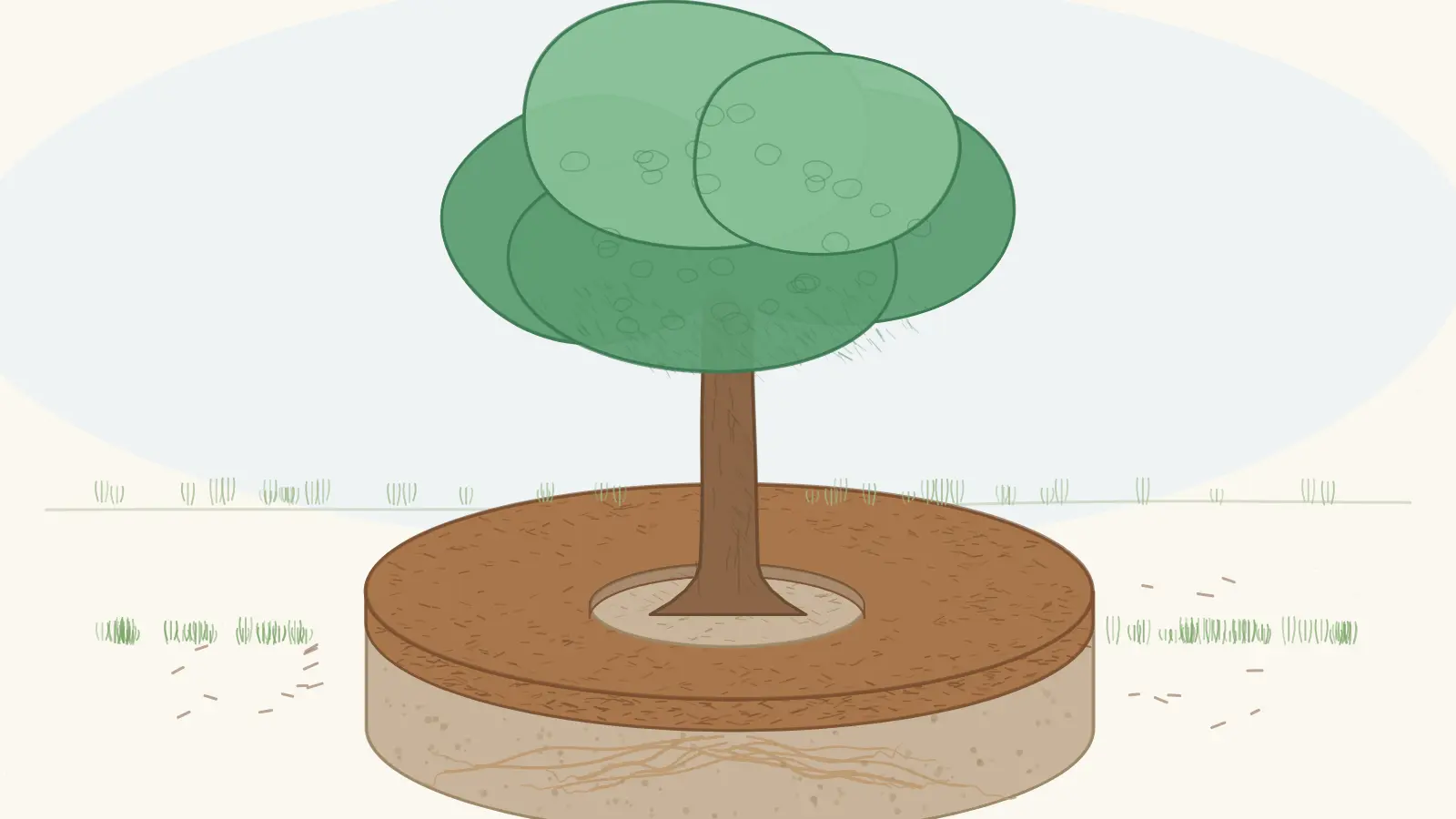
Calculating Mulch Around Trees: Avoiding Volcano Mulching
Most mulch calculators treat a tree ring like a full circle. Your tree does not. The trunk sits in the middle, and the few inches of soil around that trunk need to stay bare and open to the air.
What you are really filling is a doughnut, and if you measure it as a solid pancake you will buy more mulch than you need and, worse, you will be tempted to dump the extra where it does the most damage: against the bark.
That pile has a name in the tree care world. It is called volcano mulching, and it is one of the most common yard mistakes in America.
- Measure the outer diameter of the ring you want and the diameter of the bare circle you will leave at the trunk.
- Ring area in square feet = 3.14 x (outer radius x outer radius minus inner radius x inner radius).
- Cubic yards = ring area x depth in inches ÷ 324.
- Aim for 3 inches deep at the outer edge, thinning to nothing before the mulch reaches the bark.
- Leave 3 to 6 inches of bare soil around the trunk, more on large mature trees.
- Never let mulch touch the bark, and never let it climb the trunk in a cone.
If you want the numbers without doing the arithmetic, run your measurements through the mulch calculator and use the depth and gap rules below to sanity check the result.
Why a tree ring is a doughnut and not a circle
A tree ring has two edges. The outer edge is where you decide the ring should stop. The inner edge is the open collar of soil around the trunk. Mulch only belongs in the band between them.
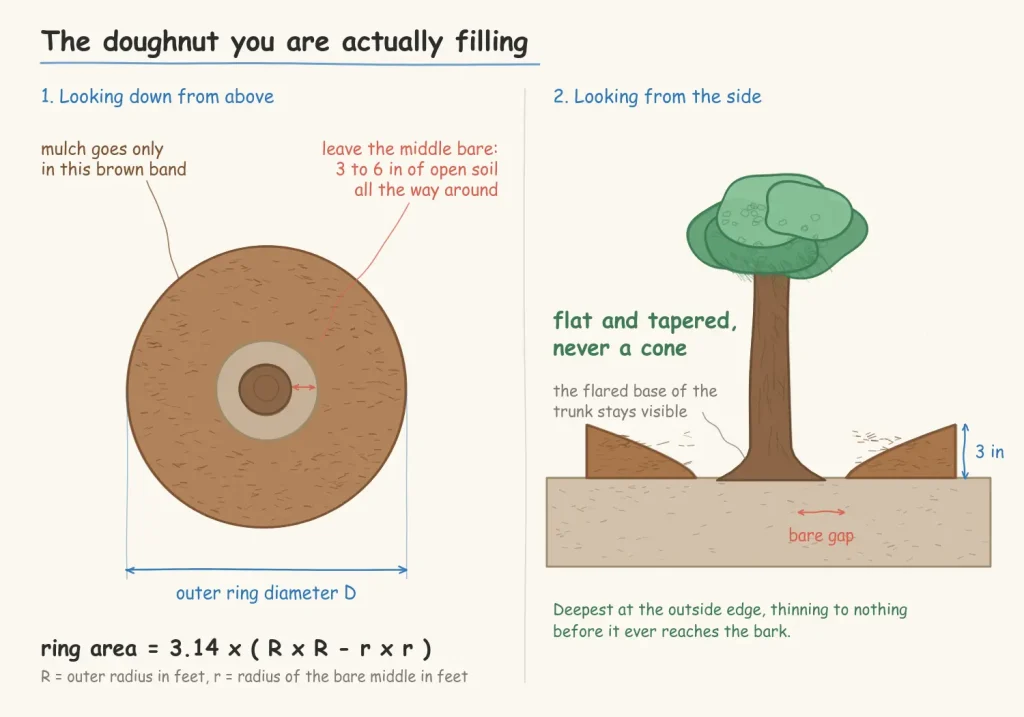
That inner hole does real work. Bark is not built to sit wet. Root systems are not built to breathe through a foot of wood chips. A systematic review of mulch research published in Arboriculture and Urban Forestry found that the standard 2 to 4 inch recommendation is well supported, that negative effects show up mostly above 4 inches, and that piling mulch high enough to raise the soil profile against the stem is linked to girdling roots later on.
So the doughnut is not a style choice. It is the shape that lets you get the benefits of mulch without the damage.
The formula, step by step
Step 1. Find your two radii.
Radius is half the diameter. If your ring will be 6 feet across, the outer radius is 3 feet. If you are leaving an 18 inch bare circle at the trunk, that is 1.5 feet across, so the inner radius is 0.75 feet.
Step 2. Get the ring area.
Ring area = 3.14 x (3 x 3 minus 0.75 x 0.75) = 3.14 x (9 minus 0.5625) = 26.5 square feet.
Step 3. Turn area into volume.
Cubic feet = area x depth in inches ÷ 12. At 3 inches deep: 26.5 x 3 ÷ 12 = 6.6 cubic feet.
Cubic yards = area x depth in inches ÷ 324. That is 26.5 x 3 ÷ 324 = 0.25 cubic yards.
Step 4. Turn volume into bags.
A standard bag holds 2 cubic feet, so 6.6 ÷ 2 = 3.3 bags. Buy 4.
That is the whole method. The only number people get wrong is the inner radius, because they forget it exists.
How much you overbuy by ignoring the hole
The smaller the ring, the more the bare center matters. With an 18 inch open collar at the trunk:
| Ring outer diameter | Ring area (sq ft) | If you ignore the hole | You overbuy by |
|---|---|---|---|
| 3 ft | 5.3 | 7.1 sq ft | 33% |
| 4 ft | 10.8 | 12.6 sq ft | 16% |
| 5 ft | 17.9 | 19.6 sq ft | 10% |
| 6 ft | 26.5 | 28.3 sq ft | 7% |
| 8 ft | 48.5 | 50.3 sq ft | 4% |
| 12 ft | 111.3 | 113.1 sq ft | 2% |
On a young tree with a small ring you can waste a third of your order. On a big shade tree the difference is small, so measure the outer edge carefully instead.
Bag counts for common tree rings
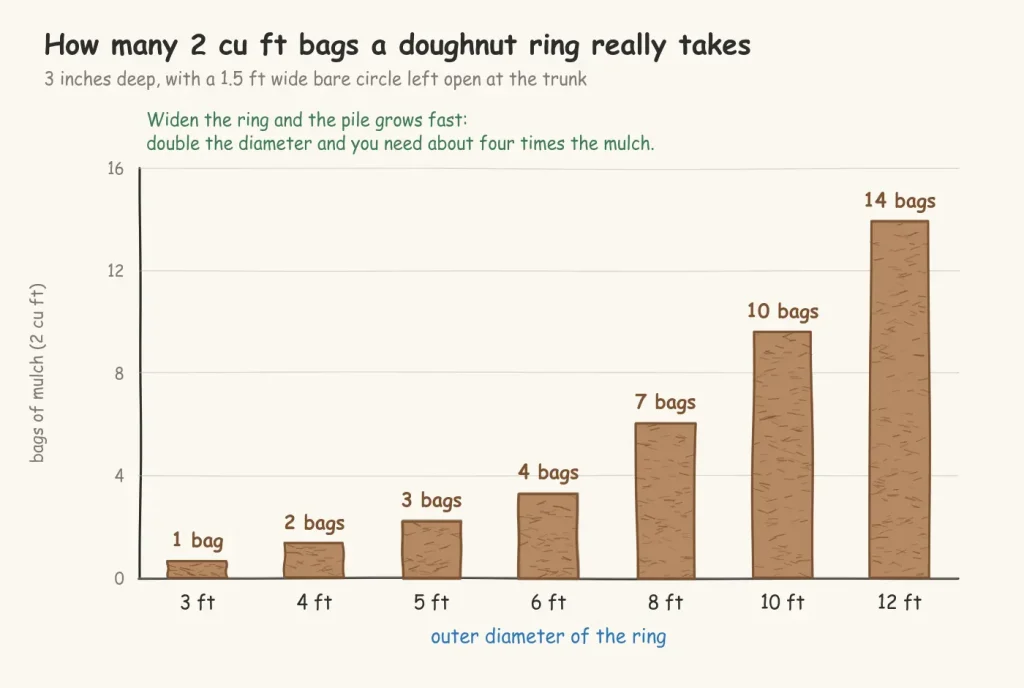
These are worked out at 3 inches deep with an 18 inch bare circle at the trunk. Round up when you buy.
| Ring diameter | Ring area | Cubic feet | Cubic yards | 2 cu ft bags | 3 cu ft bags |
|---|---|---|---|---|---|
| 3 ft | 5.3 sq ft | 1.3 | 0.05 | 1 | 1 |
| 4 ft | 10.8 sq ft | 2.7 | 0.10 | 2 | 1 |
| 5 ft | 17.9 sq ft | 4.5 | 0.17 | 3 | 2 |
| 6 ft | 26.5 sq ft | 6.6 | 0.25 | 4 | 3 |
| 8 ft | 48.5 sq ft | 12.1 | 0.45 | 7 | 5 |
| 10 ft | 76.8 sq ft | 19.2 | 0.71 | 10 | 7 |
| 12 ft | 111.3 sq ft | 27.8 | 1.03 | 14 | 10 |
Notice how fast the numbers climb. Going from a 6 foot ring to a 12 foot ring is not double the mulch, it is roughly four times, because area grows with the square of the radius. That is the single biggest budget surprise in mulching.
If you are deciding between bags and a bulk load, one cubic yard equals 27 cubic feet, which is 13.5 bags of 2 cubic feet or 9 bags of 3 cubic feet. The full breakdown is in this guide on how many bags of mulch are in a yard. As a rule, once you pass about 8 or 9 bags, bulk usually wins on price.
Coverage cheat sheet
One cubic yard of mulch covers:
- 324 sq ft at 1 inch
- 162 sq ft at 2 inches
- 108 sq ft at 3 inches
- 81 sq ft at 4 inches
So a yard of mulch handles roughly four 6 foot rings at 3 inches deep.
The taper trick that saves about a quarter of your mulch
A tree ring does not need to be a uniform slab. Best practice is to taper it, thick at the outer edge and thinning to nothing near the trunk. That taper is not just safer, it is cheaper.
Take the same 6 foot ring with an 18 inch bare center. A flat 3 inch slab needs 6.6 cubic feet. A ring that starts at 1 inch near the inner edge and rises to 3 inches at the outside needs only 4.9 cubic feet. That is a saving of about 27 percent, roughly one and a half bags on a single tree.
Now flip it around. A typical mulch volcano, about 3 feet across at the base and a foot tall against the trunk, holds about 2.4 cubic feet of mulch. That is more than a full bag of material spent on the one part of the tree that should have stayed bare.
Practical takeaway: order for a flat 3 inch ring, then taper as you spread. The leftover is your top up for next season.
What volcano mulching actually does to a tree
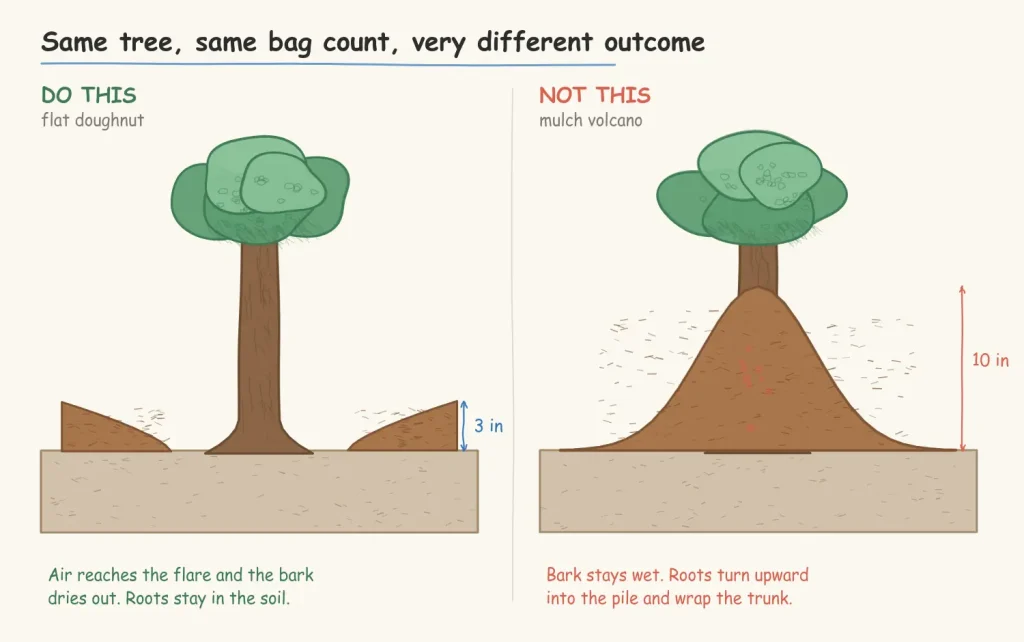
A mulch volcano does not kill a tree in a weekend. It kills slowly, which is exactly why people keep doing it.
Bark stays wet and starts to break down. Trunk bark is adapted to open air. Held against damp mulch through the season, the outer bark softens and the living tissue underneath becomes an easy target for rot and boring insects.
Roots grow up into the pile. Fine roots follow moisture and air. When the moist layer is a foot of chips against the stem, roots grow up into it and then circle the trunk. Years later those stem girdling roots squeeze the trunk from the outside. A study in Urban Forestry and Urban Greening found that the deeper the material sitting over the structural roots, the greater the share of the trunk circumference wrapped by girdling roots.
Oxygen gets scarce at the root zone. Fine textured, matted mulch can cut soil oxygen even at modest depths, and the deeper the pile the worse it gets.
Rodents move in. A tall dry pile against the bark is winter shelter for voles and mice, and they chew bark when other food runs out.
Depth alone changes survival odds. In one field study, tree deaths rose from under 5 percent at 2 inches, to 15 percent at 4 inches, to 35 percent at 6 inches.
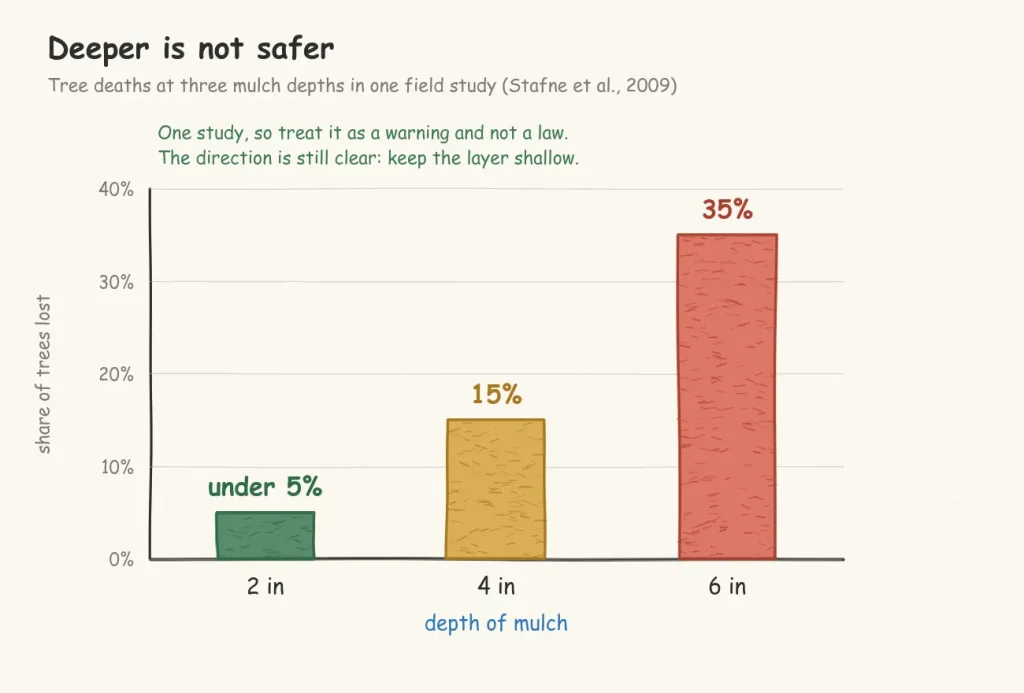
One study is not a law of nature, and results vary with soil, species and climate. But the direction is consistent across the literature, and no study in the review above found harm from staying inside the 2 to 4 inch range. Shallow is the safe bet.
How to lay a tree ring the right way
- Mark the outer edge first. Tie a string to a stake at the trunk, cut it to your radius, and walk a circle. On established trees, wider is better. Growing the ring out toward the drip line does more good than piling the same mulch deeper.
- Find the root flare. That is the point where the trunk widens into the ground. If you cannot see it, pull back soil and old mulch until you can. The flare should be visible when you finish, every time.
- Clear the old layer. Measure what is already there. If you have 2 inches of last year’s mulch, you only need about 1 more inch to reach 3, not a fresh 3 inches on top. Break up any matted crust with a rake so water can get through.
- Kill the grass, do not bury it. Cut the sod or smother it. Skip plastic sheeting, which blocks air and water exchange.
- Dump outside, rake inward. Empty the bags near the outer edge and pull the mulch toward the trunk, stopping short. Doing it in this direction makes an even layer almost automatic.
- Cut the collar. Sweep back a clean 3 to 6 inch gap of bare soil around the trunk. On mature trees, 8 to 10 inches is better.
- Feel the edge with your hand. The outer edge should be about as deep as the length of your thumb, roughly 3 inches. Near the collar it should feel like almost nothing.
- Water it in. A soak settles the layer and stops light bark chips from blowing off.
The 3-3-3 memory rule: 3 inches deep, at least a 3 foot radius, and 3 inches of bare space around the trunk. It is not a substitute for measuring, but it is the fastest way to spot a bad job from across the yard.
Ring size by tree size
| Tree | Suggested ring diameter | Bare collar | Bags at 3 in (2 cu ft) |
|---|---|---|---|
| Newly planted whip | 3 to 4 ft | 3 in | 1 to 2 |
| Young tree, trunk 2 to 4 in | 5 to 6 ft | 3 to 4 in | 3 to 4 |
| Medium tree, trunk 6 to 10 in | 8 ft | 6 in | 7 |
| Mature shade tree | 10 to 12 ft or out to the drip line | 8 to 10 in | 10 to 14 |
A ring that stops at the trunk does almost nothing for a mature tree, because most of the absorbing roots are far out under the canopy. Width beats depth every time.
Picking the material, briefly
Shredded hardwood, pine bark and arborist wood chips all work. Chips break down into the soil and feed it, which is the main benefit organic mulch has over rock.
Research comparing mulch types found soil temperatures ran highest and moisture lowest under mineral mulches such as stone, while organic mulches held conditions steadier, reported in Arboriculture and Urban Forestry.
Work on urban tree pits published in a 2019 study points the same way, with organic mulches improving soil physical and chemical properties more than the alternatives.
Two cautions. Very fine, dyed or double shredded mulch mats down and sheds water, so keep it on the thin side of the range and fluff it each spring. And rubber mulch does nothing for the soil.
Weight, delivery and hauling
Volume tells you what to order. Weight tells you whether you can move it. Mulch runs roughly 400 to 800 pounds per cubic yard depending on the material and how wet it is, so:
- A 6 foot ring at 3 inches, about 0.25 cubic yards, is roughly 100 to 200 pounds.
- A 12 foot ring at 3 inches, about 1 cubic yard, is roughly 400 to 800 pounds.
That is 8 to 16 wheelbarrow trips for the big ring. If you are pricing a truckload or checking what your trailer can carry, this breakdown of how much a yard of mulch weighs has the ranges by material.
Topping up an existing ring
Do not re-mulch on autopilot. Push a screwdriver or your finger down through the layer at three spots around the ring and measure what is there.
- 3 inches already: skip it, just rake to loosen the surface.
- 2 inches: add 1 inch. On a 6 foot ring that is about 2.2 cubic feet, so a single bag plus a little.
- Over 4 inches: pull material off and spread it out to a wider ring rather than adding more.
One inch of top up on a 6 foot doughnut is only 26.5 x 1 ÷ 12 = 2.2 cubic feet, or about 1.1 bags. Most people buy four and dump the rest where it hurts.
Mistakes that quietly cost you money or a tree
- Measuring the ring as a full circle on a small tree and overbuying by a third.
- Adding 3 fresh inches on top of 3 old inches every spring until the layer is 8 inches deep.
- Burying the root flare so the trunk looks like a telephone pole going into the ground.
- Making the ring deep instead of wide.
- Sheeting plastic underneath, which starves the soil of air.
- Piling mulch against the trunks of shrubs and hedges too, which has the same effect at a smaller scale.
If you already have a volcano
Fix it now, not next season. Pull the mulch back from the trunk with your hands or a light rake until you can see the root flare and the bark is dry to the touch.
Spread that material outward to widen the ring. If you find roots already circling the trunk, small ones can be cut cleanly, but anything thick or wrapped tight around the stem is a job for a certified arborist. The tree can often be saved if the flare is uncovered before the girdling roots get large.
Frequently Asked Questions (FAQs)
How do I calculate mulch for a tree ring?
Measure the outer diameter of the ring and the diameter of the bare circle at the trunk. Halve both to get radii. Ring area = 3.14 x (outer radius squared minus inner radius squared). Multiply the area by depth in inches and divide by 324 for cubic yards, or by 12 for cubic feet.
How many bags of mulch for a 6 foot tree ring?
At 3 inches deep with an 18 inch bare center, you need 6.6 cubic feet, which is 4 bags of 2 cubic feet or 3 bags of 3 cubic feet.
How deep should mulch be around a tree?
Two to four inches, and 3 inches is a good target for most yards. Measure what is already on the ground and only add the difference.
How far should mulch be from the trunk?
At least 3 inches of bare soil for a young tree, and 8 to 10 inches for a large mature tree. The root flare must stay visible.
Is volcano mulching really that bad?
Yes. It keeps bark wet, invites rot and boring insects, encourages roots to grow up and girdle the trunk, and shelters bark chewing rodents. The damage shows up years later, which is why the habit survives.
Should I remove old mulch before adding new?
Not always. If the total depth will stay at or below 3 to 4 inches, rake the old layer to break the crust and top up. If it is already deeper than 4 inches, remove some and spread it into a wider ring.
Can I just make the ring bigger instead of deeper?
Yes, and you should. A wider ring at 3 inches protects far more root area than a narrow deep pile, and it keeps mowers and string trimmers away from the trunk.
Does mulch really help that much?
It does. Classic field work reported in Arboriculture and Urban Forestry found higher root densities and significantly higher soil moisture under mulched ground, along with steadier soil temperatures. Mulch is one of the cheapest things you can do for a tree. It just has to be laid as a doughnut, not a volcano.

About the Author
Qazi Raza – Technical Creator & Researcher
Qazi Raza develops construction, engineering, and home‑improvement calculators by researching verified formulas, industry standards, and authoritative reference materials. His tools are built using data from ASTM specifications, ASHRAE guidelines, NEC tables, building codes, and widely accepted engineering textbooks. Each calculator is designed to help homeowners, DIYers, and contractors make accurate, confidence‑based decisions.