
How Many Square Feet Does a Ton of Gravel Cover?
One ton of gravel covers about 120 square feet at 2 inches deep. At 1 inch it stretches to roughly 240 square feet. At 3 inches you get about 80, and at 4 inches only about 60.
If you are standing in a landscaping yard right now with the sales guy waiting on an answer, that is the number you needed.
Everything below is for the moment after, when you want to know whether you should order 3 tons or 5, and whether the pile you just paid for will actually finish the job.
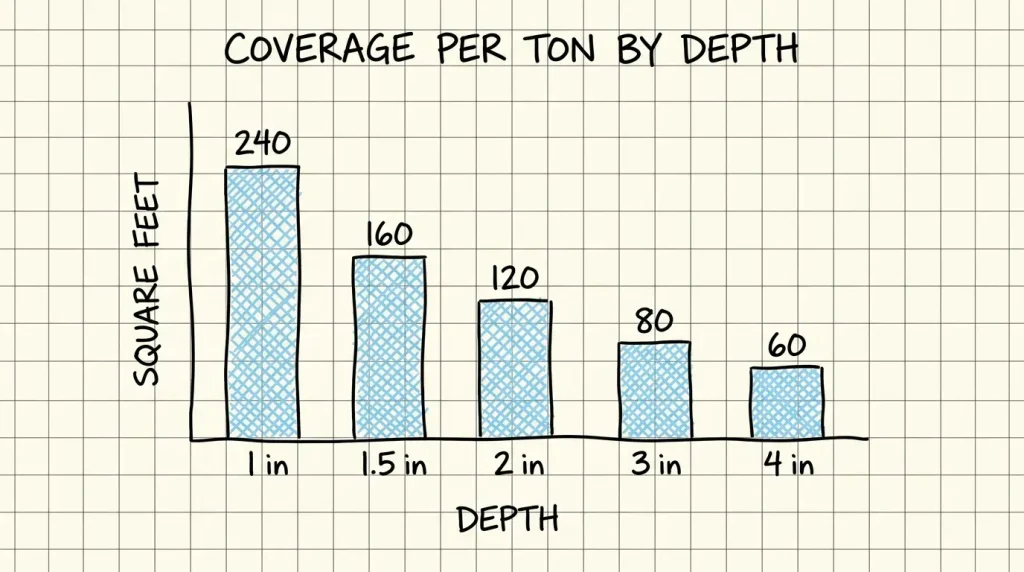
Coverage per ton at every common depth
This chart assumes standard crushed stone at roughly 2,700 pounds per cubic yard, which is what most yards sell for driveways, paths, and beds.
| Depth | Sq ft per ton | Tons per 100 sq ft |
|---|---|---|
| 1 inch | 240 sq ft | 0.42 tons |
| 1.5 inches | 160 sq ft | 0.63 tons |
| 2 inches | 120 sq ft | 0.83 tons |
| 2.5 inches | 96 sq ft | 1.04 tons |
| 3 inches | 80 sq ft | 1.25 tons |
| 4 inches | 60 sq ft | 1.67 tons |
| 5 inches | 48 sq ft | 2.08 tons |
| 6 inches | 40 sq ft | 2.50 tons |
| 8 inches | 30 sq ft | 3.33 tons |
| 12 inches | 20 sq ft | 5.00 tons |
Coverage per cubic yard at every common depth
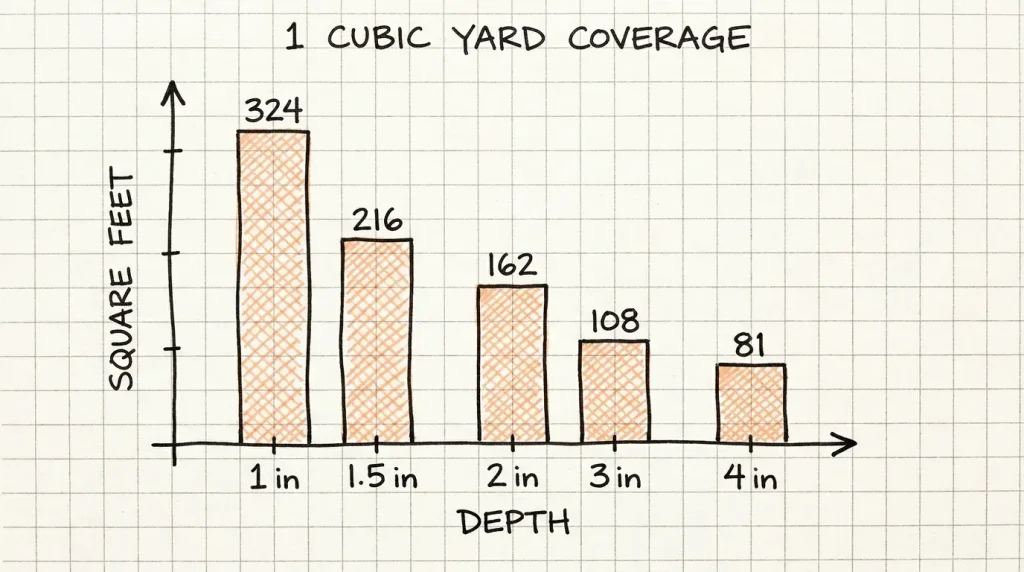
Some yards sell by the ton. Others sell by the cubic yard. You need both numbers, because the same pile is described two different ways depending on who you call.
One cubic yard covers about 162 square feet at 2 inches deep.
| Depth | Sq ft per cubic yard | Cubic yards per 100 sq ft |
|---|---|---|
| 1 inch | 324 sq ft | 0.31 yd³ |
| 1.5 inches | 216 sq ft | 0.46 yd³ |
| 2 inches | 162 sq ft | 0.62 yd³ |
| 2.5 inches | 130 sq ft | 0.77 yd³ |
| 3 inches | 108 sq ft | 0.93 yd³ |
| 4 inches | 81 sq ft | 1.23 yd³ |
| 5 inches | 65 sq ft | 1.54 yd³ |
| 6 inches | 54 sq ft | 1.85 yd³ |
| 8 inches | 40 sq ft | 2.47 yd³ |
| 12 inches | 27 sq ft | 3.70 yd³ |
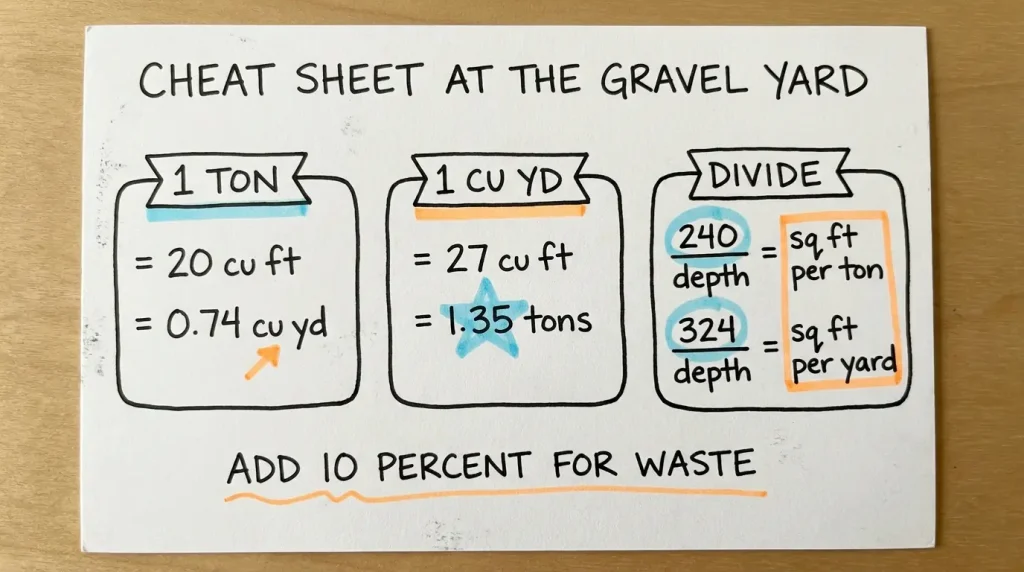
Do not mix the two units. A cubic yard is not a ton. For typical crushed stone, 1 cubic yard is about 1.35 tons, and 1 ton is about 0.74 cubic yards. Confusing them is the single most expensive mistake in gravel ordering.
The math behind the numbers
Gravel is priced by weight but installed by volume. Bridging that gap takes two steps.
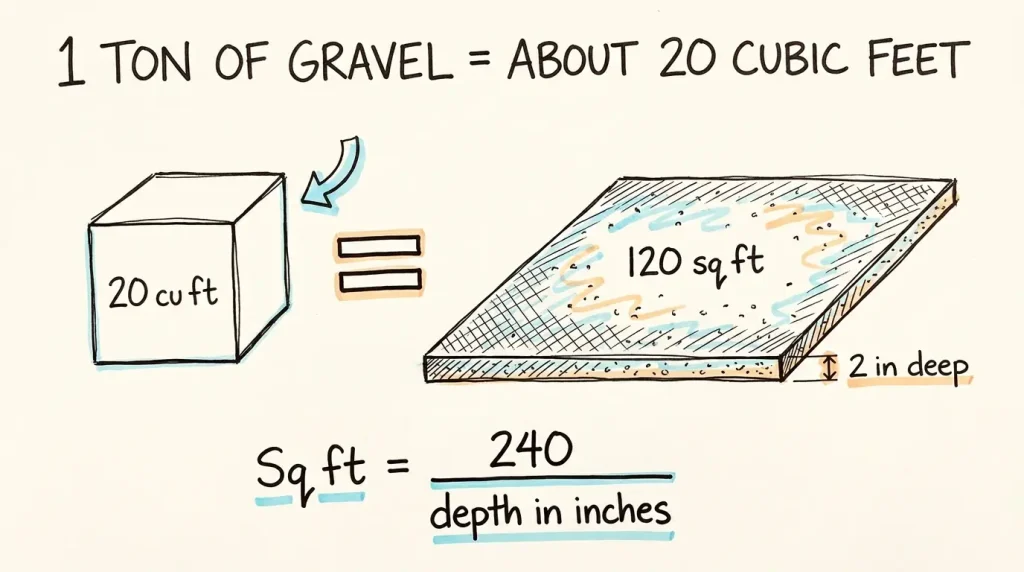
Step 1: Turn a ton into volume. Most crushed stone weighs about 2,700 pounds per cubic yard. A ton is 2,000 pounds.
- 2,000 ÷ 2,700 = 0.74 cubic yards per ton
- 0.74 × 27 cubic feet per yard = about 20 cubic feet per ton
Step 2: Divide by your depth. Depth has to be in feet, so 2 inches becomes 0.167 feet.
- 20 ÷ 0.167 = 120 square feet
Two shortcuts worth memorizing
Square feet per ton = 240 ÷ depth in inches
Square feet per cubic yard = 324 ÷ depth in inches
That is it. The 240 comes from 20 cubic feet × 12 inches. The 324 comes from 27 cubic feet × 12 inches. Divide by your depth and you have your answer standing in the parking lot.
Flip it around when you know your area:
Tons needed = (square feet × depth in inches) ÷ 240
Cubic yards needed = (square feet × depth in inches) ÷ 324
A 500 sq ft patio at 3 inches deep: (500 × 3) ÷ 240 = 6.25 tons, or (500 × 3) ÷ 324 = 4.6 cubic yards.
If you would rather let something else do the arithmetic once you are back home, the gravel calculator handles odd shapes, multiple layers, and waste factors in one pass.
Not all gravel weighs the same, and that changes everything
Coverage is driven by density, and density varies by 2x across common landscaping products. In materials testing, this property is called bulk density or unit weight, and it is measured under a standard procedure precisely because it changes with particle shape, gradation, and moisture. Here is what one ton actually covers at 2 inches deep, by material:
| Gravel type | Approx. lb per cubic yard | Sq ft per ton at 2″ | Sq ft per cu yd at 2″ |
|---|---|---|---|
| Lava rock / volcanic | 1,200–1,500 | 200–260 | 162 |
| Pea gravel (3/8″) | 2,400–2,600 | 125–135 | 162 |
| #57 crushed stone (3/4″) | 2,600–2,800 | 115–125 | 162 |
| River rock (1–2″) | 2,650–2,800 | 110–120 | 162 |
| Decomposed granite | 2,800–3,000 | 100–110 | 162 |
| Crusher run / dense grade | 2,900–3,100 | 95–105 | 162 |
Notice the last column never moves. Volume-based coverage is the same no matter what the stone weighs. Only tonnage changes. That is a real argument for buying by the cubic yard when you can; the number you get is the number you spread.
The pattern in plain terms: the more fine material (dust, screenings, sand) a product contains, the tighter it packs, the more a cubic yard weighs, and the less ground one ton covers. Clean, uniform, rounded stone has more air between the particles and stretches further.
Practical rule: switching from pea gravel to crusher run on the same project means ordering roughly 25% more tonnage for the same square footage.
Ask the yard one question: “What does this product weigh per cubic yard?” Most quarries know the number for their own stockpile, and it beats every online average, including this one. It takes ten seconds and eliminates the biggest source of error in gravel estimates.
How deep should you actually go?
Coverage is meaningless without the right depth. Spreading a driveway 2 inches thick to stretch a ton just means re-graveling next spring.
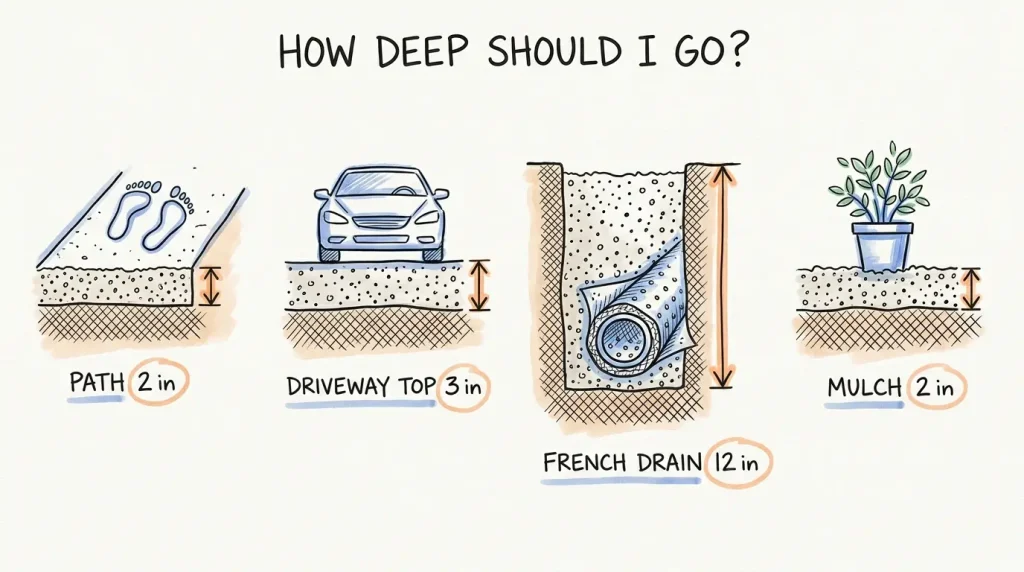
| Project | Depth | Tons per 100 sq ft | Cu yd per 100 sq ft |
|---|---|---|---|
| Decorative bed / gravel mulch | 2 in | 0.83 | 0.62 |
| Walking path | 2–3 in | 0.83–1.25 | 0.62–0.93 |
| Dog run or play area | 2–3 in | 0.83–1.25 | 0.62–0.93 |
| Driveway top layer (refresh) | 3 in | 1.25 | 0.93 |
| Paver or patio base | 4 in | 1.67 | 1.23 |
| Shed or RV pad | 4–6 in | 1.67–2.50 | 1.23–1.85 |
| New driveway, full build | 8–12 in in layers | 3.33–5.00 | 2.47–3.70 |
| Drainage trench | Full trench depth | Volume-based | Volume-based |
A new driveway is not one order. It is typically a 4-inch base of larger angular stone, sometimes a middle course, and a 2–3 inch top layer. Each layer needs its own calculation, and the layers often use different products at different prices.
The compaction factor almost nobody tells you about
This is the reason people say “I ordered exactly what the chart said and it still looks thin.”
Delivered gravel is loose. Once you rake it, drive on it, or run a plate compactor over it, it settles. Dense-graded materials with fines can lose 15–25% of their loose volume. Clean single-size stone settles less, usually under 10%.
Highway research on granular bases has spent decades on exactly this question, because achieving target density in the field is genuinely hard and varies across a site. So if you want a finished 4-inch compacted base, spread closer to 5 inches loose, about 25% more material.
| Finished depth you want | Loose depth to spread | Sq ft per ton | Sq ft per cu yd |
|---|---|---|---|
| 2 in compacted | ~2.5 in | ~96 | ~130 |
| 3 in compacted | ~3.75 in | ~64 | ~86 |
| 4 in compacted | ~5 in | ~48 | ~65 |
Swell-and-settle percentages differ by product, and they matter most on anything structural. The gravel compaction rate guide breaks the numbers down by stone type.
Skip this correction for decorative beds. Mulch gravel is supposed to stay loose. Only apply a compaction factor when the layer will be driven on, built on, or paved over.
Three real projects, start to finish
A 40-foot garden path, 3 feet wide, 2 inches deep
- Area: 40 × 3 = 120 sq ft
- Tons: (120 × 2) ÷ 240 = 1.0 ton
- Cubic yards: (120 × 2) ÷ 324 = 0.74 yd³
This is the classic one-ton job, and it makes a useful benchmark. If your project is meaningfully bigger than a small garden path, one ton will not cover it.
A 60 × 12 ft driveway refresh, 3 inches deep
- Area: 720 sq ft
- Tons: (720 × 3) ÷ 240 = 9 tons
- With a 10% waste factor: 10 tons
A tandem dump truck typically carries 10–14 tons, so this is one delivery. Ordering 9 versus 10 tons often costs nearly the same once the delivery fee is spread across the load.
A 30-foot drainage trench, 12 inches wide, 18 inches of stone
Trenches are volume problems, not area problems:
- Volume: 30 × 1 × 1.5 = 45 cubic feet
- Tons: 45 ÷ 20 = 2.25 tons
- Cubic yards: 45 ÷ 27 = 1.67 yd³
Drainage work has extra variables; pipe displacement, fabric wrap, and washed-stone requirements all shift the number. If that is your project, work through the French drain gravel formula instead of using a surface coverage chart.
Field checks you can do without a phone
These are the sanity checks that catch big errors before the truck pulls away.
The pile check. One ton dumped on flat ground forms a cone roughly 5 feet across and 3 feet tall. A cubic yard makes a noticeably bigger pile, about 6 feet across. If your delivery looks dramatically smaller per ton than that, ask for the scale ticket.
The parking-space test. A ton spread 2 inches thick covers about the footprint of one car parking space (roughly 120 sq ft). Walk your area and count parking spaces. It is crude, and it is right more often than people expect.
The wheelbarrow count. A contractor barrow holds 6 cubic feet, but gravel is heavy enough that most people fill it halfway. Budget 7 to 10 barrow loads per ton. That also tells you how long your Saturday is going to be.
The screwdriver depth check. Push a screwdriver through the spread gravel until it hits soil, mark it with your thumb, and measure. Do it in five spots. Real spread depth drifts by an inch or more, and that drift is usually why you run short at the far end of the driveway.
Quick conversions for the phone call
| Unit | Equivalent |
|---|---|
| 1 ton | ~0.74 cubic yards |
| 1 ton | ~20 cubic feet |
| 1 cubic yard | ~1.35 tons |
| 1 cubic yard | 27 cubic feet |
| 1 ton | ~40 bags at 50 lb |
| 1 cubic yard | ~54 bags at 0.5 cu ft |
Bags vs. bulk: bagged gravel usually runs 3–5x the price per ton of a bulk delivery. The break-even sits around half a ton. Below that, bags are simpler. Above it, order bulk even if you have to rent a trailer.
What does that work out to per square foot?
Depth decisions are budget decisions, and this is the math that shows it:
Cost per sq ft = (price per ton + delivery share) ÷ coverage per ton
Say stone runs $45 per ton and delivery adds $10 per ton on a 10-ton order. Your effective cost is $55 per ton.
- At 2 inches (120 sq ft per ton): about $0.46 per square foot
- At 3 inches (80 sq ft per ton): about $0.69 per square foot
- At 4 inches (60 sq ft per ton): about $0.92 per square foot
This is also why rounding up on the first delivery beats a second trip. A second delivery fee often costs more than the extra stone you would have bought.
Mistakes that trigger a second delivery
- Forgetting to convert inches to feet. Depth must be divided by 12 before multiplying. Skipping this produces answers 12 times too large.
- Treating tons and cubic yards as the same thing. They differ by about 35% for typical stone.
- Squaring off curved beds. Break irregular shapes into rectangles, triangles, and circles, calculate each, then add. Rounding a curved bed into a rectangle usually underestimates by 10–15%.
- Leaving out a waste factor. Add 5–10% for spillage, uneven subgrade, and stone that disappears into soft spots. Add more on rutted or sloped ground.
- Ignoring edges and slopes. Gravel migrates downhill and past unedged borders. Anything over a 5% slope needs edging or you will top it up every year.
- Calculating a vertical fill like a surface spread. Backfilling behind a retaining wall is a column of stone, not a layer. Use a wall gravel backfill calculation for those drainage columns.
Frequently asked questions (FAQs)
How many square feet does 1 ton of gravel cover at 2 inches deep?
About 120 square feet for standard crushed stone. Pea gravel covers a bit more (125–135 sq ft) and crusher run a bit less (95–105 sq ft).
How many square feet does a cubic yard of gravel cover?
About 162 square feet at 2 inches, 108 at 3 inches, and 81 at 4 inches. A cubic yard covers roughly 35% more ground than a ton.
How many tons of gravel do I need for 1,000 square feet?
At 2 inches, about 8.3 tons. At 3 inches, about 12.5 tons. At 4 inches, about 16.7 tons.
How many tons are in a cubic yard of gravel?
About 1.35 tons for typical crushed stone. Lightweight products like lava rock can be under 1 ton per yard, and dense crusher run can approach 1.5.
Will 1 ton of gravel cover a driveway?
Almost never. A single-car driveway of 600 square feet at 3 inches needs about 7.5 tons. One ton covers roughly 80 square feet at driveway depth, about one parking spot’s worth.
How much area does 5 tons of gravel cover?
About 600 square feet at 2 inches, 400 at 3 inches, or 300 at 4 inches.
Should I order by the ton or by the cubic yard?
If you have the choice, cubic yards are easier to plan with, because volume coverage does not change with stone density. If the yard only quotes tons, ask for the weight per cubic yard so you can convert accurately.
How much extra should I order?
Add 5% on flat, well-prepped ground and 10% on uneven or sloped ground. Add another 15–25% on top of that if the layer will be compacted.
The bottom line
Memorize two numbers and you will never be stuck at a landscaping yard again: 240 divided by your depth in inches gives square feet per ton, and 324 divided by your depth gives square feet per cubic yard. Then ask the quarry what their stone weighs per yard, add 10% for waste, and add another 20% if you plan to compact it.
References and further reading
- ASTM International. ASTM C29/C29M — Standard Test Method for Bulk Density (“Unit Weight”) and Voids in Aggregate. The reference method for determining loose and compacted bulk density and the void content between aggregate particles.
- American Concrete Institute. ACI Education Bulletin E1-15: Aggregates for Concrete. Defines bulk density as the mass of aggregate divided by the volume of particles plus the voids between them, and explains why gradation and particle shape change that value.
- Transportation Research Board, National Cooperative Highway Research Program. NCHRP Research Results Digest 57: Density Standards for Field Compaction of Granular Bases and Subbases. Examines the degree of compaction actually attainable in granular base construction.
- Karan, P., Larkin, T., and Wilson, D. J. (2017). Vibratory Compaction of Base Course Aggregates. Transportation Research Record, No. 2655. Documents the persistent gap between laboratory target densities and densities achieved in the field.
Reviewed for accuracy against published aggregate density standards. Coverage figures are engineering estimates based on typical crushed stone at 2,700 lb per cubic yard. Always confirm the actual unit weight of the product your supplier is selling before placing a large order.

About the Author
Qazi Raza – Technical Creator & Researcher
Qazi Raza develops construction, engineering, and home‑improvement calculators by researching verified formulas, industry standards, and authoritative reference materials. His tools are built using data from ASTM specifications, ASHRAE guidelines, NEC tables, building codes, and widely accepted engineering textbooks. Each calculator is designed to help homeowners, DIYers, and contractors make accurate, confidence‑based decisions.