
French Drain Gravel Formula: Pipe Displacement Volume Calculation
Most gravel estimates for a French drain are wrong in the same small way. They treat the trench as if it were one solid box of stone. It is not. A perforated pipe sits inside that box, and the pipe takes up space that gravel never fills. That missing space is called pipe displacement, and ignoring it means you order stone you do not need.
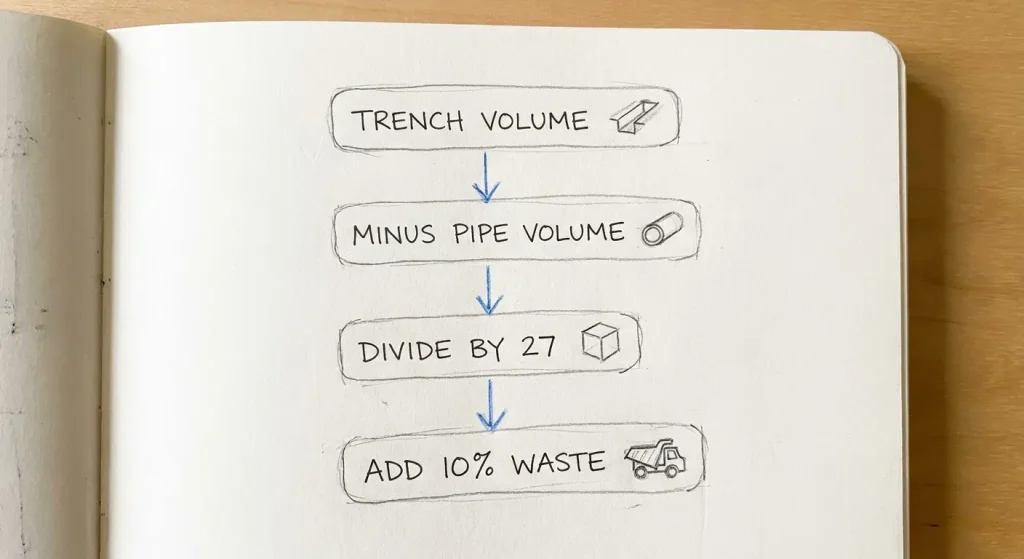
Gravel volume equals trench volume minus pipe volume. In cubic feet, that is L x W x D minus 3.1416 x r x r x L, where r is the pipe’s outside radius in feet. Divide the result by 27 for cubic yards, then add 5 to 10 percent for settling and waste. A 4 inch corrugated pipe removes about 0.11 cubic feet of gravel per linear foot, or roughly 0.41 cubic yards per 100 feet.
What the French drain gravel formula is
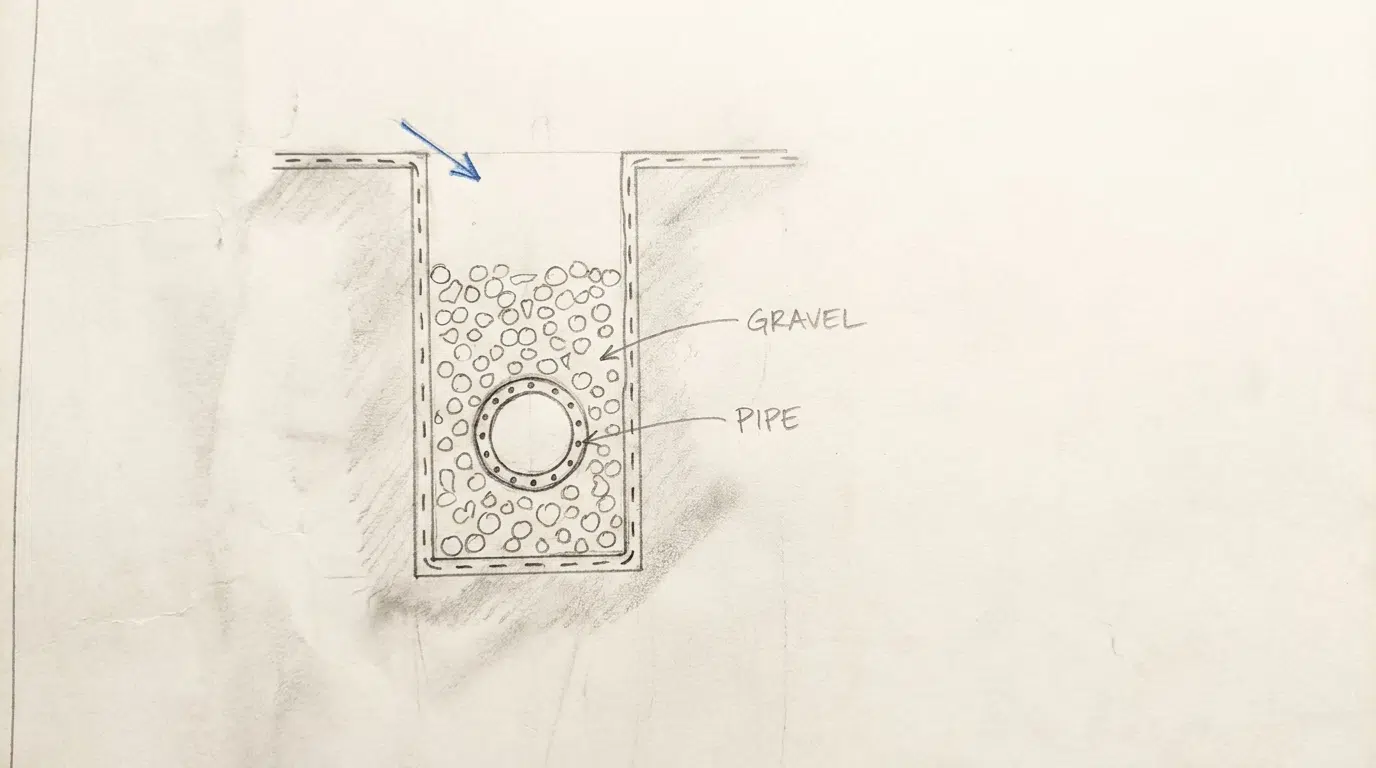
A French drain is a gravel filled trench with a perforated pipe near the bottom. Water moves through the voids between the stones, drops into the pipe, and flows downhill to a discharge point. So the stone fills everything in the trench except the pipe itself. That gives you a two part formula.
Step 1. Trench volume, in cubic feet
Trench volume = Length x Width x Depth
Step 2. Pipe displacement volume, in cubic feet
Pipe volume = 3.1416 x r x r x Length
Step 3. Gravel volume
Gravel = Trench volume – Pipe volume
Step 4. Convert and pad
Cubic yards = Gravel cubic feet / 27, then multiply by 1.05 to 1.10.
Every measurement must be in feet before you multiply. Width and depth are almost always given in inches, so divide those by 12 first. A 12 inch wide trench is 1 foot. An 18 inch deep trench is 1.5 feet.
Why pipe displacement is worth the extra math
On a small patio drain, the pipe barely matters. On a long run, it adds up fast.
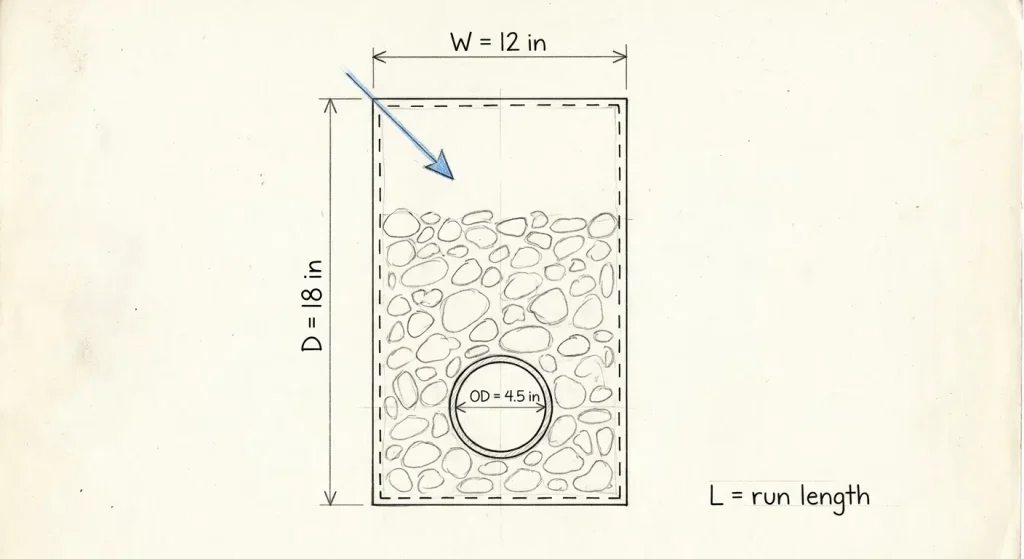
In a 12 inch wide by 18 inch deep trench, a 4 inch corrugated pipe removes about 7.4 percent of the total volume. That is close to a tenth of your stone order. In a narrow 8 inch trench, the same pipe removes about 11 percent. In a wide 24 inch by 36 inch trench, it removes under 2 percent.
So the rule is simple. The narrower and shallower the trench, the more the pipe changes your number. Deep and wide trenches can round the pipe away without much risk.
There is a second reason to be careful. Stone is heavy and sold in bulk, and returns are rare. A clean subtraction keeps you from paying for a half yard of washed stone that sits in your driveway all summer.
How to calculate pipe displacement volume
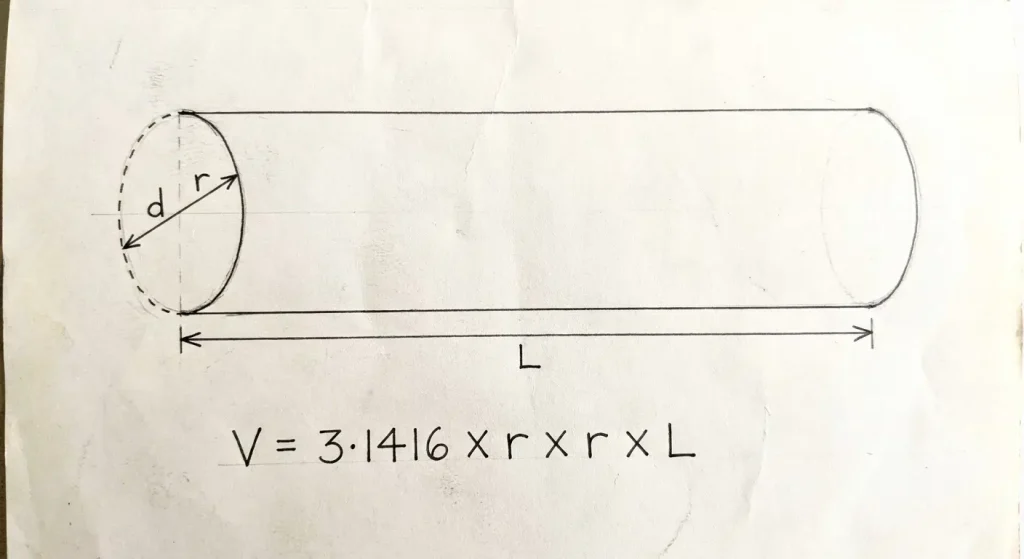
The pipe is a cylinder. The volume of a cylinder is the area of the circle times the length.
Pipe volume = 3.1416 x r x r x L
You can also work straight from the diameter, which is easier to measure:
Pipe volume = 0.7854 x d x d x L
Both d and r must be in feet. A pipe with a 4.5 inch outside diameter is 0.375 feet across, so r is 0.1875 feet.
Use the outside diameter, not the nominal size
A “4 inch” pipe is not 4 inches on the outside. The nominal size describes the rough inside opening. Gravel sits against the outside wall, so the outside diameter is what displaces stone.
Corrugated single wall HDPE drain pipe, the black flexible pipe sold in coils and covered by AASHTO M 252 and ASTM F 405, has ridges that push the outside diameter well past the nominal size. A 4 inch corrugated pipe usually measures about 4.5 inches across the corrugation crests. Rigid PVC sewer and drain pipe made to ASTM D3034 SDR 35 has a published outside diameter of 4.215 inches for the 4 inch size and 6.275 inches for the 6 inch size.
Here is what those real diameters do to your gravel order.
| Pipe | Outside diameter | Displacement per foot, cubic feet | Displacement per 100 feet, cubic yards |
|---|---|---|---|
| 3 inch corrugated HDPE | about 3.5 in | 0.067 | 0.25 |
| 4 inch corrugated HDPE | about 4.5 in | 0.110 | 0.41 |
| 4 inch PVC SDR 35 | 4.215 in | 0.097 | 0.36 |
| 6 inch corrugated HDPE | about 6.5 in | 0.230 | 0.85 |
| 6 inch PVC SDR 35 | 6.275 in | 0.215 | 0.80 |
If your pipe comes wrapped in a fabric sock, add roughly a quarter inch to the outside diameter. The change is small, but it is free to include.
A full worked example, 50 foot run
Say you are draining a soggy side yard. The trench is 50 feet long, 12 inches wide, and 18 inches deep. You are using 4 inch corrugated perforated pipe with the holes facing down.
Convert to feet
- Length: 50 ft
- Width: 12 in / 12 = 1 ft
- Depth: 18 in / 12 = 1.5 ft
- Pipe outside diameter: 4.5 in / 12 = 0.375 ft, so r = 0.1875 ft
Trench volume
50 x 1 x 1.5 = 75 cubic feet
Pipe displacement volume
3.1416 x 0.1875 x 0.1875 x 50 = 5.52 cubic feet
Gravel volume
75 - 5.52 = 69.48 cubic feet
Cubic yards
69.48 / 27 = 2.57 cubic yards
Add 10 percent for settling and waste
2.57 x 1.10 = 2.83 cubic yards
Order 3 cubic yards. Without the displacement step you would have landed on 3.06 yards before padding and probably ordered 3.5. The pipe alone saved you about a fifth of a yard, and the honest rounding saved another half yard.
Gravel per linear foot for common trench sizes
If you would rather skip the algebra on site, use these net numbers. They already have a 4 inch corrugated pipe subtracted.
| Trench size | Gross volume per foot, cubic feet | Net gravel per foot, cubic feet | Net gravel per 100 feet, cubic yards |
|---|---|---|---|
| 8 in wide x 18 in deep | 1.00 | 0.89 | 3.3 |
| 12 in wide x 18 in deep | 1.50 | 1.39 | 5.1 |
| 12 in wide x 24 in deep | 2.00 | 1.89 | 7.0 |
| 18 in wide x 24 in deep | 3.00 | 2.89 | 10.7 |
| 24 in wide x 36 in deep | 6.00 | 5.89 | 21.8 |
These assume stone runs from the trench bottom to the top. If you cap the trench with 3 or 4 inches of topsoil or sod, subtract that depth before you multiply. On a 50 foot run, a 4 inch soil cap removes about 0.6 cubic yards of stone from the order.
When you want the arithmetic handled for you, the gravel calculator turns trench dimensions into yards and tons in one pass.
Turning cubic yards into tons
Many suppliers sell washed drainage stone by weight. Clean angular 3/4 inch stone, often sold as number 57 or number 67, runs around 1.35 to 1.5 tons per cubic yard, depending on the parent rock and how wet it is.
Tons = cubic yards x 1.4
For the 50 foot example above, 2.83 cubic yards is about 4 tons. Round bagged stone weighs a little less per yard than crushed granite or trap rock, so ask your yard for the actual unit weight if the order is large. Bulk density and void content are measured under ASTM C29, and any quarry can hand you that sheet.
Settling, compaction, and the padding factor
Stone shifts. When you place clean 3/4 inch aggregate in a trench and then walk it, tamp it, or let a season of rain move it, the particles reseat into a tighter arrangement. The surface drops. You will need a little more stone than the raw geometry says.
For open graded drainage stone, 5 to 10 percent extra is usually plenty. Ten percent is the safer choice on long runs, in wet soil, or when the trench walls are ragged and bulge outward. Excavated trenches are almost never as neat as the rectangle you measured.
Do not confuse this with heavy mechanical compaction. Drainage stone should stay loose and clean so voids stay open. If you plate compact French drain gravel like road base, you crush the fine points off the aggregate and reduce the very void space you are paying for.
For the difference between simple settlement allowance and true compacted density, the guide on gravel compaction rate breaks down the swell and shrink factors.
How much water the gravel actually holds
Gravel volume and water storage are two different numbers, and people mix them up constantly.
Only the void space between the stones holds water. Clean single sized drainage aggregate typically has a porosity around 0.35 to 0.40, so about 35 to 40 percent of the stone volume is open.
Laboratory work on crushed stone drainage layers confirms that porosity and saturated hydraulic conductivity fall sharply once sand or fines enter the mix, which is exactly why washed stone is specified instead of bank run gravel or crusher fines.
Water stored in gravel = gravel cubic feet x porosity x 7.48 gallons
For the 50 foot example, 69.48 cubic feet of stone at 0.38 porosity holds about 26 cubic feet of water, or roughly 197 gallons. The pipe itself adds about 4.4 cubic feet, another 33 gallons. That total is the buffer your trench provides during a storm before it depends purely on outflow.
This is also why the pipe is not wasted space. It is the fastest path in the system. The stone is storage and filter, and the pipe is the highway.
Stone choice affects the math you should trust
Use clean, washed, angular stone in the 3/4 inch to 1.5 inch range. Avoid anything sold as base rock, crusher run, or paver base. Those products contain fines by design so they lock up tight, which is perfect under a driveway and terrible in a drain.
Rounded pea gravel packs into a denser arrangement with smaller pores and migrates more easily, so it drains more slowly than angular stone of the same nominal size.
Research on aggregate shape shows that flatter and more elongated particles produce higher void ratios than regular rounded shapes, which is one reason crushed angular stone keeps its drainage capacity for decades.
A non woven geotextile wrap, the burrito method, keeps soil out of those voids. Decades of subsurface drainage research on pipe envelopes exist for exactly this reason. Envelopes must balance two conflicting jobs, letting water in freely while blocking soil particles from entering and clogging the system.
Bedding, cover, and what the standards expect
Geometry alone will not make the drain work. A few placement rules keep the trench from failing.
- Put 2 to 3 inches of stone under the pipe as bedding, so the pipe is not resting on raw soil.
- Keep at least 6 inches of stone over the pipe where you can.
- Slope the line at a minimum of 1 percent, which is 1/8 inch of drop per foot, toward a lower discharge point.
- Face the perforations down. Water rises into the pipe from the bottom of the gravel bed rather than waiting to reach the top of the pipe.
- Compact bedding and haunch material as required for the pipe you are using. Underground installation of thermoplastic drain pipe is covered by ASTM D2321, which sets out embedment classes and the material and compaction expectations around the pipe.
One useful side note: Your bedding depth changes the stone volume. If the pipe invert sits 2 inches above the trench floor, the stone still fills that space, so it stays in the calculation. What does not stay in the calculation is any depth you plan to fill with soil, sod, or a decorative cap.
Vertical drainage columns behind walls use the same idea
The subtract the pipe principle is not limited to horizontal trenches. Behind a retaining wall you have a vertical column of free draining stone with a collector pipe at the base, and the same displacement logic applies to the pipe run along the footing.
The column volume, the chimney width, and the pipe all interact. If that is your project, see the walkthrough on wall gravel backfill calculation and estimating drainage columns.
Mistakes that throw the number off
- Using nominal pipe size as the outside diameter. A 4 inch corrugated pipe is closer to 4.5 inches outside. That is a 27 percent difference in displaced volume.
- Mixing inches and feet. Convert everything to feet before multiplying, not after.
- Forgetting the divide by 27. A cubic yard is 3 x 3 x 3 feet, not 9 cubic feet.
- Counting the soil cap as stone. If the top 4 inches are topsoil, that depth is not gravel.
- Padding twice. Add one waste factor, not a waste factor plus a generous round up plus an extra half yard for comfort.
- Assuming the trench is a perfect rectangle. Hand dug trenches bulge. Machine dug trenches over cut. Field measure the widest point if you want to avoid a second delivery.
- Buying stone with fines to save money. It will pack, hold water, and fail. The cheapest stone is the one you do not have to dig out again.
Frequently asked questions (FAQs)
Do I really need to subtract the pipe volume?
Calculate the displacement for each pipe and subtract both. Two 4 inch corrugated pipes in a 50 foot trench remove about 11 cubic feet of stone, which is close to half a cubic yard.
Does the fabric sock change the volume?
Barely. A sock adds roughly a quarter inch to the outside diameter, which on 50 feet of 4 inch pipe is about 0.6 extra cubic feet of displacement. Include it if you want precision, ignore it if you are already padding 10 percent.
How do I handle a trench that changes depth?
Split the run into segments of consistent depth, calculate each one, then add them. A drain that starts 18 inches deep and finishes 30 inches deep can be treated as an average depth of 24 inches if the slope is steady, but segment math is more accurate.
Should I use cubic yards or tons when ordering?
Order in whatever unit your supplier sells in, but calculate in cubic yards first because your trench is measured by volume. Convert to tons only at the end, using the yard’s actual unit weight.
How much extra should I order?
Five percent for a clean, machine cut trench in stable soil. Ten percent for hand dug trenches, soft or wet ground, long runs, or anything where a second trip to the supply yard would ruin your day.
The formula in one place
Gravel cubic feet = (L x W x D) – (3.1416 x r x r x L)
Gravel cubic yards = Gravel cubic feet / 27
Order quantity = Gravel cubic yards x 1.05 to 1.10
Tons = Order quantity x 1.4All dimensions in feet.
r = pipe OUTSIDE radius, not nominal size.
Measure the trench, use the real outside diameter, subtract the cylinder, convert once, and pad once. That is the whole job.
References and further reading
- Lim, H. et al. “Investigating the Hydraulic Properties of Unsaturated Crushed Stone Aggregate to Enhance Horizontal Drainage Systems on Soft Ground.” Advances in Civil Engineering, 2022. onlinelibrary.wiley.com/doi/10.1155/2022/8384987
- Minnesota Department of Transportation. Drainability of Base Aggregate and Sand, research report on hydraulic conductivity, porosity, and void ratio of drainage aggregates. rosap.ntl.bts.gov/view/dot/58397
- Bahceci, I. et al. “A New Drainpipe Envelope Concept for Subsurface Drainage Systems in Irrigated Agriculture.” Irrigation and Drainage, 2018. onlinelibrary.wiley.com/doi/full/10.1002/ird.2247
- Vlotman, W. F. et al. “Research and developments in selecting subsurface drainage materials.” Irrigation and Drainage Systems, Springer.
- American Society of Agricultural and Biological Engineers. “Gravel Envelopes for Pipe Drains, Design.” Transactions of the ASAE.
- Byrne, I. Assessment of Materials Used in Land Drainage Systems, University of Galway, review of gravel and synthetic envelope design criteria.
- Hydrogeologic Properties of Earth Materials and Principles of Groundwater Flow, Section 3.4, Void Ratio and porosity relationships.

About the Author
Qazi Raza – Technical Creator & Researcher
Qazi Raza develops construction, engineering, and home‑improvement calculators by researching verified formulas, industry standards, and authoritative reference materials. His tools are built using data from ASTM specifications, ASHRAE guidelines, NEC tables, building codes, and widely accepted engineering textbooks. Each calculator is designed to help homeowners, DIYers, and contractors make accurate, confidence‑based decisions.