
Nominal vs. Actual Lumber Sizing (The Standard Milled Sizing Cheat Sheet)
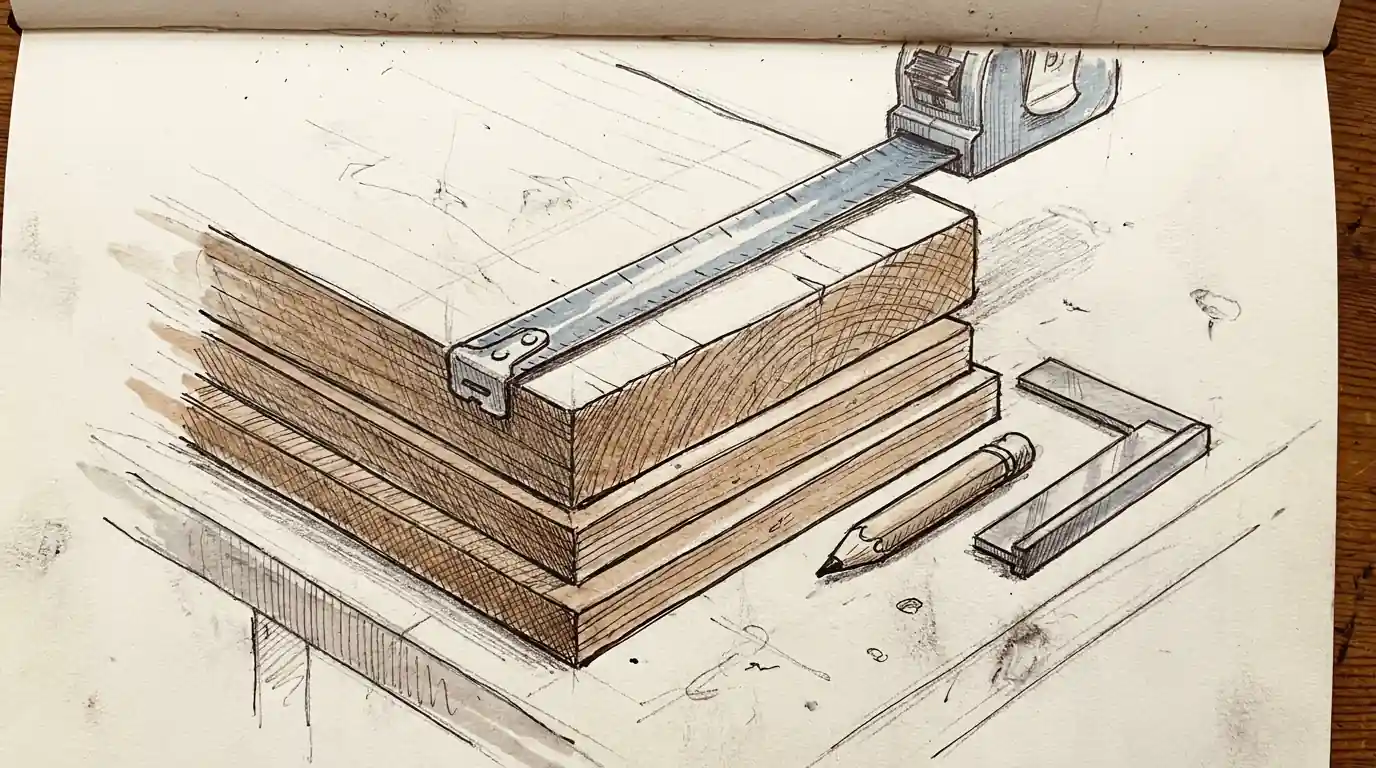
You walk into the lumberyard, ask for ten 2x4s, and load them into the truck feeling good. Then you get home, hook your tape over the end of one, and the number reads 1.5 inches by 3.5 inches. Nothing was cut wrong. Nobody shorted you. That board was never going to be a full 2 by 4.
This one gap is behind more layout mistakes than any other beginner problem in carpentry. It throws off wall thickness, door and window framing, shelf spacing, cabinet openings, and every drawing where somebody typed “2 inches” into a plan. The fix is simple: stop drafting from the name on the tag and start drafting from the finished size.
Nominal size is the name the lumber industry sells by, like 2×4 or 1×6. Actual size (also called the dressed size or the finished size) is what you can measure with your tape after the board has been dried and surfaced on all four sides, which the yard labels S4S. Quick version you can memorize in ten seconds:
- Boards under 2 inches nominal thickness lose 1/4 inch. A 1x is 3/4 inch thick.
- Nominal 2 through 4 inch dimensions lose 1/2 inch. A 2×4 is 1.5 x 3.5 inches.
- Nominal 8 inches and wider lose 3/4 inch. A 2×8 is 7.25 inches wide, not 7.5.
- Timbers 5 inches and thicker lose about 1/2 inch on both faces, so a 6×6 is 5.5 x 5.5 inches.
- Length is honest. An 8 foot stud really is 96 inches. Only thickness and width are nominal.
Those finished numbers are not each mill’s opinion. They are fixed in the U.S. Department of Commerce Voluntary Product Standard PS 20, the American Softwood Lumber Standard, which is why a stud from Oregon and a stud from Georgia drop into the same wall without an argument.
The standard milled sizing cheat sheet
All numbers below are for surfaced, dry (S4S, S-DRY or KD) North American softwood: pine, spruce, fir, hemlock, cedar, and southern yellow pine. Millimeter values are rounded the way suppliers publish them.
1x lumber (boards, trim, shelving)
| Nominal size | Actual size (inches) | Actual size (mm) |
|---|---|---|
| 1×2 | 3/4 x 1-1/2 | 19 x 38 |
| 1×3 | 3/4 x 2-1/2 | 19 x 64 |
| 1×4 | 3/4 x 3-1/2 | 19 x 89 |
| 1×5 | 3/4 x 4-1/2 | 19 x 114 |
| 1×6 | 3/4 x 5-1/2 | 19 x 140 |
| 1×8 | 3/4 x 7-1/4 | 19 x 184 |
| 1×10 | 3/4 x 9-1/4 | 19 x 235 |
| 1×12 | 3/4 x 11-1/4 | 19 x 286 |
2x lumber (studs, joists, rafters, framing)
| Nominal size | Actual size (inches) | Actual size (mm) |
|---|---|---|
| 2×2 | 1-1/2 x 1-1/2 | 38 x 38 |
| 2×3 | 1-1/2 x 2-1/2 | 38 x 64 |
| 2×4 | 1-1/2 x 3-1/2 | 38 x 89 |
| 2×6 | 1-1/2 x 5-1/2 | 38 x 140 |
| 2×8 | 1-1/2 x 7-1/4 | 38 x 184 |
| 2×10 | 1-1/2 x 9-1/4 | 38 x 235 |
| 2×12 | 1-1/2 x 11-1/4 | 38 x 286 |
4x lumber (posts, beams, headers)
| Nominal size | Actual size (inches) | Actual size (mm) |
|---|---|---|
| 4×4 | 3-1/2 x 3-1/2 | 89 x 89 |
| 4×6 | 3-1/2 x 5-1/2 | 89 x 140 |
| 4×8 | 3-1/2 x 7-1/4 | 89 x 184 |
| 4×10 | 3-1/2 x 9-1/4 | 89 x 235 |
| 4×12 | 3-1/2 x 11-1/4 | 89 x 286 |
6x timbers (heavy posts, pergolas, retaining walls)
| Nominal size | Actual size (inches) | Actual size (mm) |
|---|---|---|
| 6×6 | 5-1/2 x 5-1/2 | 140 x 140 |
| 6×8 | 5-1/2 x 7-1/2 | 140 x 191 |
| 6×10 | 5-1/2 x 9-1/2 | 140 x 241 |
| 6×12 | 5-1/2 x 11-1/2 | 140 x 292 |
Notice the change in pattern at the 6x row. Wide 1x and 2x stock gives up 3/4 inch once you pass 6 inches, but timbers 5 inches and thicker only give up about 1/2 inch. That is why a 6×8 is 7-1/2 inches wide while a 2×8 is only 7-1/4 inches wide. Mixing those two up is a classic way to end up with a beam pocket that does not line up.
The odd sizes
| Product | Sold as | Actual size (inches) |
|---|---|---|
| Radius edge decking | 5/4×6 | 1 x 5-1/2 |
| Furring strip | 1×2 furring | 3/4 x 1-1/2 |
| Green (unseasoned) post | 4×4 S-GRN | 3-9/16 x 3-9/16 |
| Rough sawn from a small mill | 2×4 rough | Close to a true 2 x 4 |
| Hardwood from a hardwood dealer | 4/4, 6/4, 8/4 | Sold by quarter inch of rough thickness, roughly 13/16 after surfacing for 4/4 |
The hardwood point matters if you shop at both kinds of yards. Softwood is sold by a nominal cross section, hardwood is sold by rough thickness in quarters of an inch. A “4/4” board is not a 1x. Plan on about 13/16 inch after it is surfaced on two sides.
When you are pricing a run of framing or decking, feed these dressed numbers into our lumber calculator rather than the nominal name, and your material list will match what actually shows up on the pallet.
Why the wood shrinks: two steps, not one
People usually blame “drying” alone. It is really two separate steps stacked on top of each other, and knowing which one caused what keeps you from being surprised later.
Step 1: sawing and surfacing take material off
A log gets broken down into rough, oversized cants and boards. That rough board is fuzzy, slightly cupped, and never a consistent thickness end to end. To make it flat, straight, and safe to handle, the mill runs it through planer heads that shave every face.
Surfaced four sides, S4S, means all four faces got shaved. Each pass removes real material, and the industry long ago agreed on how much would come off so the finished piece stays predictable.
Step 2: drying pulls the fibers in
Fresh cut wood is soaked. Water sits both inside the cell cavities as free water and inside the cell walls as bound water. Here is the part that surprises most beginners: the board does not start shrinking as soon as it loses water.
Free water leaves first with almost no change in size. Shrinkage only begins when the bound water inside the cell walls starts to leave, at roughly 28 to 30 percent moisture content, which is called the fiber saturation point. This behavior is documented in detail in the USDA Forest Service publication Moisture Relations and Physical Properties of Wood.
After that point, the wood keeps pulling in as it dries, and it does not pull in evenly. Wood moves most across the growth rings (tangentially), about half as much toward the center of the log (radially), and almost nothing along its length.
Microscope level work on softwood, such as this study on moisture related shrinkage behavior of wood at the macroscale and cellular level, traces that behavior back to how the cell walls and lumens collapse as bound water leaves. Species and growth rate change the numbers too, as shown in this model of tangential, radial, and longitudinal shrinkage in commercial conifers.
That directional behavior explains the one detail most charts never explain: why wide boards lose more than narrow ones. Thickness always comes off the short direction, so a 2x loses a flat 1/2 inch. Width runs across the rings, where the wood shrinks the most, so wide stock loses more.
Once you get past 6 inches nominal, that loss is big enough that the standard writes it in as 3/4 inch instead of 1/2 inch. Same species, same kiln, different geometry.
Step 3: the standard locks the number in
Modern mills do not saw a true 2 by 4 and hope for the best. They saw slightly oversize, dry the load to a target moisture content, plane it, and hit the finished dimension on purpose. Kiln drying is what makes that repeatable, since it brings a whole load to a controlled moisture content instead of whatever the weather allowed.
The Forest Products Laboratory chapter on drying and control of moisture content and dimensional changes covers the target values used for construction lumber, generally 19 percent or less for framing and 6 to 8 percent for furniture and millwork.
So the honest one line answer to “why isn’t a 2×4 two by four” is this: the name is a leftover from the rough green size of the 1800s, and the number on your tape is the modern engineered result of drying plus planing.
Read the grade stamp before you trust the tape
Here is where two boards labeled 2×4 can genuinely measure differently. PS 20 has two size schedules, one for green lumber and one for dry lumber, set up so both end up about the same size once they settle in service. The grade stamp tells you which one you bought.
| Stamp | Moisture content | What it means for your measurement |
|---|---|---|
| S-GRN | Over 19 percent, unseasoned | Milled slightly fat, near 1-9/16 x 3-9/16 for a 2×4, and it will shrink toward 1-1/2 x 3-1/2 as it dries |
| S-DRY | 19 percent or less | Standard 1-1/2 x 3-1/2, the usual big box stud |
| KD or KD-HT | Kiln dried, 19 percent or less | Same finished size, dried in a kiln, HT means heat treated |
| MC-15 or KD-15 | 15 percent or less | Most stable option, best for interior work and finish carpentry |
Pressure treated stock is the trap. It usually gets treated after surfacing and often arrives still heavy with treatment solution. It measures on size or a hair fat when wet, then loses width as it dries out on your job site. If you are building a deck, that is exactly why gapping decking too tight in spring can leave you with wide gaps by late summer.
The layout math
A chart tells you a 2×4 is 3.5 inches. It does not tell you what that costs you across a whole assembly. This is where beginners actually get burned, because the error multiplies every time a piece is stacked.
Stacked pieces multiply the error
| What you stack | Nominal math says | Real measurement | Error |
|---|---|---|---|
| 2 pieces of 2x lumber, face to face | 4 in | 3 in | 1 in short |
| Bottom plate plus double top plate | 6 in | 4-1/2 in | 1-1/2 in short |
| Four 2×10 joists sistered | 8 in | 6 in | 2 in short |
| Five 1x boards stacked flat | 5 in | 3-3/4 in | 1-1/4 in short |
| Ten 2x4s stacked flat | 20 in | 15 in | 5 in short |
That middle row is the one that decides whether your walls come out at the right height. An 8 foot wall is not built from 96 inch studs. It uses a 92-5/8 inch precut stud plus 4-1/2 inches of real plate thickness, which lands at 97-1/8 inches of rough height. That extra bit is deliberate, giving room for floor and ceiling finishes while still letting two 4 foot sheets of drywall stack cleanly.
Wall and opening thicknesses you should be drafting
| Assembly | Real thickness |
|---|---|
| 2×4 wall, framing only | 3-1/2 in |
| 2×4 wall with 1/2 in drywall both sides | 4-1/2 in |
| 2×6 wall with 1/2 in drywall both sides | 6-1/2 in |
| 2×4 wall, drywall inside, 1/2 in sheathing plus siding outside | 5 in plus siding |
| Jamb width for a 2×4 wall | 4-9/16 in standard |
That 4-9/16 inch door jamb number exists precisely because of nominal versus actual. It is 3-1/2 plus two layers of 1/2 inch drywall plus a small allowance. If you draft a 4 inch wall because “a 2×4 is 4 inches,” your prehung doors will not fit the wall you built.
You are billed on nominal, and that is worth knowing
Board footage is calculated from nominal size, not actual size. A 2x4x8 counts as 5.33 board feet. The wood you carry out measures 1.5 x 3.5 x 96 inches, which is 3.5 board feet of real material. You are paying by a name that describes about one third more wood than you receive.
This is not a scam, it is just the industry unit, and every supplier prices against it. But it changes how you compare options. When a 6×6 post and four 2x6s sound close in price, run both through actual cross sections before you decide.
Our lumber calculator handles the board foot conversion and the dressed size lookup in the same place, so you can compare real material instead of names.
Your lumber is still moving after you buy it
A kiln dried stud at 19 percent moisture that goes into a heated, conditioned house will keep drying until it reaches equilibrium with the indoor air, usually somewhere around 8 to 10 percent.
Wood keeps trading moisture with the air around it for its whole life, which is the core idea behind equilibrium moisture content research and the reason nothing built from wood is ever perfectly static.
A useful field rule from that body of work: expect roughly 1 percent change in width or thickness for every 4 percent change in moisture content. Run that on real parts:
| Part | Dimension | Drop from 19 to 9 percent MC | Practical result |
|---|---|---|---|
| 2×4 thickness | 1-1/2 in | About 1/32 in | Ignore it |
| 2×6 width | 5-1/2 in | About 1/8 in | Noticeable at a deck gap |
| 2×12 joist depth | 11-1/4 in | Close to 1/4 in | Matters at ledgers and trim reveals |
| 6×6 post face | 5-1/2 in | About 1/8 in, plus checking | Expect surface cracks, usually cosmetic |
So the practical takeaway: use the chart to draft, and add a little tolerance where wide faces meet finished surfaces. Wood movement is normal behavior for a natural material, not a defect, and the amount is documented across species in extension guides like this one on dimensional changes in wood.
5 beginner mistakes and the fix for each
| Mistake | What goes wrong | The fix |
|---|---|---|
| Drafting a wall at 4 inches thick | Doors, jambs, and cabinet returns do not fit | Draft 3-1/2 in, or 4-1/2 in finished with drywall |
| Assuming 2×8 is 7-1/2 wide | Rim board and trim reveals come up 1/4 in off | Remember wide stock loses 3/4 in, not 1/2 in |
| Treating a 4×4 and a 6×6 the same way | Post caps and brackets do not seat | 4×4 is 3-1/2, 6×6 is 5-1/2, and hardware is sized to actual |
| Ignoring the grade stamp on wet treated stock | Decking gaps open up over the first season | Buy dry or gap for shrinkage, and check the stamp |
| Cutting a shelf dado to 1 inch for a 1x board | Sloppy joint, visible gap | Cut 3/4 in, or measure the board you actually bought |
One more habit that separates people who get clean results from people who chase mistakes: measure the actual board on your job site before you cut anything critical. Standards give you the minimum dressed size, and mill tolerance is normally within about 1/16 inch, but stock that sat in the rain or came from a small local sawmill can measure differently. Thirty seconds with a tape beats a rebuilt wall.
Quick reference to keep in your phone
- 1x thickness = 3/4
- 2x thickness = 1-1/2
- 4x thickness = 3-1/2
- 6x thickness = 5-1/2
- Widths through 6 nominal: subtract 1/2
- Widths 8 nominal and up (1x, 2x, 4x): subtract 3/4
- Timber widths 8 and up (6x and thicker): subtract 1/2
- Length: as labeled
Frequently Asked Questions (FAQs)
What is the actual size of 2×4 lumber?
A dry, surfaced 2×4 measures 1-1/2 by 3-1/2 inches, or 38 by 89 mm. Green stamped stock may start closer to 1-9/16 by 3-9/16 inches and shrink to standard size as it dries.
Why is a 2×4 called a 2×4 if it is not one?
The name comes from the rough, green size that mills cut in the 1800s before drying and planing. The label stuck as a product category even after the finished size was standardized under PS 20.
Is lumber length also nominal?
No. Thickness and width are nominal, length is real. An 8 foot board is 96 inches, and a 92-5/8 inch precut stud is exactly that.
Does pressure treated lumber measure the same?
The target sizes are the same, but treated stock is often still wet with treatment solution. It can measure full or slightly fat when you buy it, then shrink as it dries.
Why does a 2×8 lose 3/4 inch when a 2×4 only loses 1/2 inch?
Width runs across the growth rings, the direction wood shrinks most. Wider boards lose more absolute width during drying, so the standard builds a bigger allowance into wide stock.
Are hardwood boards sold the same way?
No. Hardwood is sold by rough thickness in quarters of an inch, so 4/4 means about 1 inch rough and roughly 13/16 inch after surfacing.
Can I still find true 2 by 4 lumber?
Yes, from small sawmills selling rough sawn stock and from reclaimed timber dealers. Expect it to be heavier, less consistent, and to need surfacing before finish work.
Do I use nominal or actual size when I estimate material?
Use nominal size for board footage and pricing, since that is the industry unit, and actual size for every layout, drawing, and cut list.

About the Author
Qazi Raza – Technical Creator & Researcher
Qazi Raza develops construction, engineering, and home‑improvement calculators by researching verified formulas, industry standards, and authoritative reference materials. His tools are built using data from ASTM specifications, ASHRAE guidelines, NEC tables, building codes, and widely accepted engineering textbooks. Each calculator is designed to help homeowners, DIYers, and contractors make accurate, confidence‑based decisions.
4 thoughts on “Nominal vs. Actual Lumber Sizing”
Comments are closed.