
Gravel Compaction Rate: How to Estimate Settlement and Compaction Loss
Most sub-base jobs come up short for one reason: the geometry was right, but the material was measured in the wrong state. You calculate the finished depth you want. The supplier sells you loose stone or tons based on loose density. A plate compactor then removes about a quarter of the depth you spread, and you are 1 to 2 inches thin with no material left.
How Much Does Gravel Compact
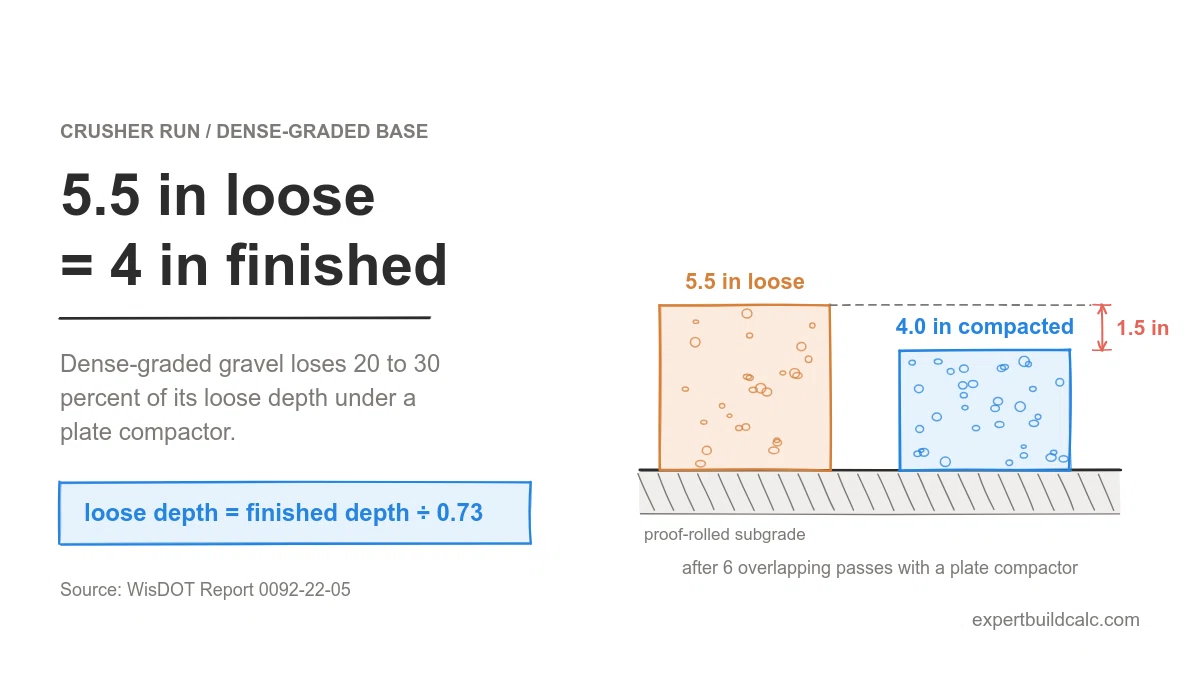
Dense-graded aggregate (crusher run, DGA, CR-6, 21A, RCA) loses 20 to 30 percent of its loose depth when it is compacted. Plan on 27 percent. Spread 5.5 inches loose for every 4 inches of finished base, and order about 37 percent more loose volume than your finished volume.
| Material | Depth lost from loose to compacted | Loose volume multiplier | Tons per compacted cubic yard |
|---|---|---|---|
| Crusher run / dense-graded aggregate (¾ in minus) | 25–32% | 1.35–1.47 | 1.75–2.1 |
| Dense-graded aggregate (1¼ in minus) | 25–34% | 1.34–1.52 | 1.75–2.0 |
| Recycled concrete aggregate, dense graded | 20–28% | 1.25–1.39 | 1.6–1.9 |
| Open-graded stone (#57, #67) | 8–12% | 1.09–1.14 | 1.4–1.5 |
| Stone dust / screenings bedding | 12–18% | 1.14–1.22 | 1.5–1.7 |
| Decorative gravel, pea gravel (not compacted) | 0–5% | 1.00–1.05 | 1.3–1.4 |
The ranges are not padding. They come from measured loose and compacted unit weights for base aggregates, published in a state highway research report on weight-volume relationships for soils and aggregates.
That study recorded volume expansion of 36 to 47 percent from compacted to loose for ¾-inch dense-graded base, and 34 to 52 percent for 1¼-inch dense-graded base. (Wisconsin DOT / Cetin, Report 0092-22-05)
Read that backwards and you get the number that matters on site: compacted volume is roughly 0.68 to 0.73 of dumped-loose volume. Material that has been spread and raked is already a little denser than dumped material, so a practical planning factor is 0.73 to 0.78.
Why the Math Fails in Two Different Ways
Most people think there is one mistake here. There are two, and they stack.
Error 1: You Calculated Finished Depth But Bought Loose Material
A 4-inch finished base is 4 inches after compaction. Loose stone dumped and screeded to 4 inches will finish near 3 inches. That is the missing inch.
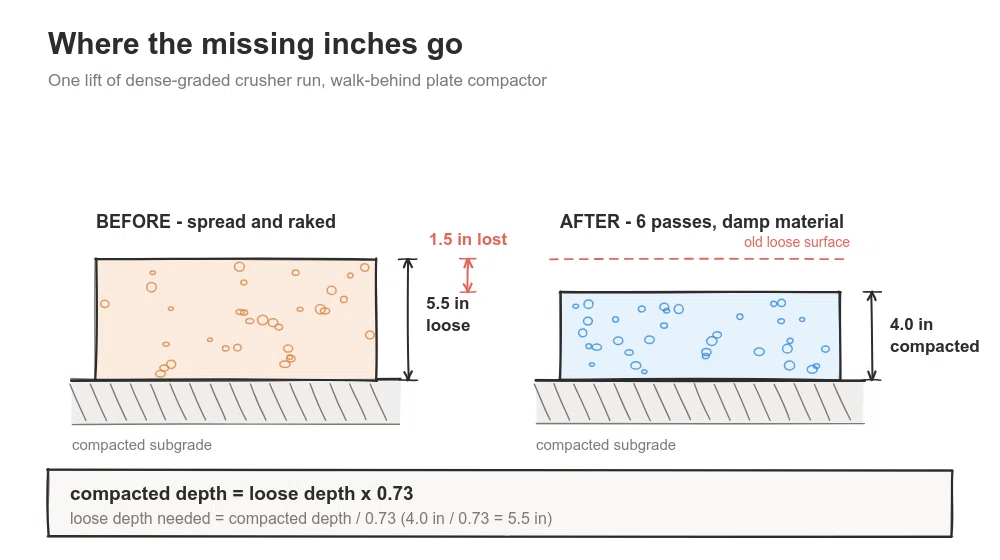
The working formulas:
compacted depth = loose depth × 0.73loose depth = compacted depth ÷ 0.73loose cubic yards to order = finished cubic yards ÷ 0.73
Error 2: You Used Loose Density to Convert Cubic Yards into Tons
This is the expensive one, and almost no calculator warns about it. Aggregate is delivered by weight. Yard-to-ton figures quoted by suppliers, usually 1.3 to 1.4 tons per cubic yard for crusher run, describe stone sitting loose in a truck. The same stone compacted in place weighs far more per cubic yard.
The research report above measured loose dry unit weights of 90 to 104 pcf for dense-graded base against compacted dry unit weights of 133 to 148 pcf, and lists compacted conversion factors of 1.75 to 2.1 tons per cubic yard. (Wisconsin DOT / Cetin, Report 0092-22-05)
If you multiply a finished volume by a loose density, you under-order by about 25 to 30 percent every single time.
Set Your Lifts so the Numbers Hold
Compaction rates only work if the compactor can actually reach the bottom of the layer. It often cannot. A 434-page state research program on lift thickness and compaction equipment tested loose lifts of 4, 8, 12 and 15 inches with rollers, rammers and vibratory plate compactors.
The finding is blunt: 15-inch lifts did not compact uniformly through their depth, 12-inch lifts were better, and 8-inch loose lifts compacted most uniformly. Vibratory plates and hand rammers performed well on thin lifts. (PennDOT / Penn State, Equipment and Lift Thickness Optimization, study record)
Highway agencies land in the same place. A study on the effective depth of compaction notes that specifications commonly cap lifts at 8 inches, and allow 12 inches only for granular soils with density testing. (WisDOT / FHWA, Effective Depth of Soil Compaction) Testing on thick granular layers found density falling well below target through the layer depth. (NZ Transport Agency, Research Report 411)
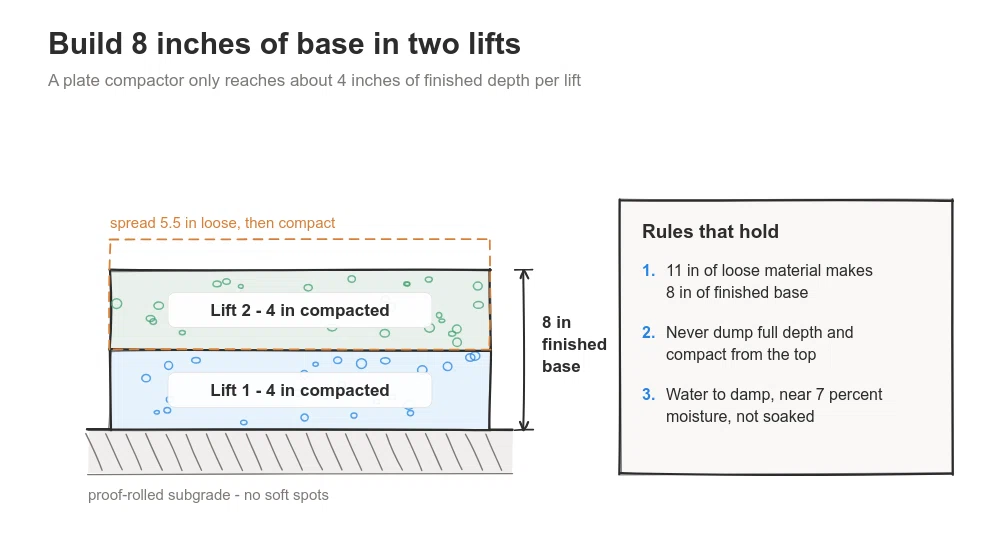
For a walk-behind plate, keep each finished lift at 4 inches or less. A heavy reversible plate can hold 6 inches.
Moisture Decides Whether You Hit the Rate at All
Dry stone will not densify. Every aggregate has an optimum moisture content, and testing on dense-graded base materials put it around 5.6 to 8.6 percent by weight, with maximum dry unit weights of 133 to 147 pcf at those moisture levels.
What this means in a driveway:
- Bone-dry crusher run will settle less under the plate, then settle more under traffic later. You did not save material. You deferred the loss.
- Damp material hits the higher compaction rate on the day, so budget the full 27 percent.
- Soaked material pumps and never reaches density. Stop and let it drain.
A squeeze test is enough: a handful should hold together and leave your palm barely damp, with no free water.
How Many Passes, and Why the Top Looks Done Before the Bottom is
Field plate load testing on aggregate base layers measured stiffness at 2, 4, 8 and 12 roller passes, and the largest gains land in the early passes before the curve flattens. (Sustainability 10(10):3817) Controlled plate-compactor experiments also show that dry density varies along the depth of a single compacted layer, so a firm surface is not proof of a compacted bottom. (Transportation Geotechnics, plate compactor frequency study)
And density is not the same everywhere on your pad. Field testing of ten aggregate base layers found real spatial variability in density and stiffness across a single job. That is why the corners and edges of a patio are usually the first spots to sink.
Practical rule: 4 to 6 overlapping passes per lift, in crossing directions, and expect no useful movement after that.
Open-graded stone is a different animal. Because it has almost no fines, it locks by turning stone faces against each other instead of by density gain. Producer specifications describe #57 stone as compacting about one inch, near 8 percent settlement, which you can see happen. (AASHTO #57 stone specification sheet; on the strength behavior of these gradations, see FHWA-HRT-15-034 and Sustainability 12(6):2521)
Measure Your Own Compaction Rate in 20 Minutes
Published ranges are for ordering. A calibration patch gives you your number, for your stone, at today’s moisture. Do this on the first delivery, before you order the rest.
- Pick a 10 ft × 10 ft area on the prepared subgrade.
- Drive two stakes and mark the finished base height on both.
- Spread one lift and screed it flat. Measure the loose depth in four spots and write down the average.
- Make 6 overlapping passes with the plate, half of them at 90 degrees to the others.
- Measure the depth again in the same four spots.
- Divide compacted depth by loose depth. That decimal is your compaction factor.
If you get 0.75, then every 4 inches of finished base needs 5.3 inches of loose stone, and your total loose order is your finished volume ÷ 0.75. Use your measured number instead of the table.
How to Set the Waste Slider Before You Order
Run your dimensions through the gravel calculator first, using the finished depth you actually want. Then adjust for how the material is sold.
If the result is in loose cubic yards or bags:
- Dense-graded aggregate (crusher run, DGA, CR-6, 21A, RCA): +35 to 40 percent
- Open-graded stone (#57, #67) under pavers or as drainage stone: +10 percent
- Stone dust or screenings bedding: +15 percent
- Decorative gravel with no compaction: +5 percent
If the result is in tons, check the density the tool used:
- Tool used a loose figure near 1.3–1.4 tons per cubic yard: +35 percent
- Tool used a compacted figure near 1.9–2.0 tons per cubic yard: no compaction add
Then add for site conditions, on top of the number above:
- Soft, wet or clay subgrade that will take stone during proof-rolling: +5 to 10 percent
- Curves, circles or anything not rectangular: +5 percent
- Sloped grade where you feather depth: +5 percent
Do not stack a generic 10 percent “waste” factor on top of a compaction factor and assume it is covered. They pay for different things. Compaction loss is a volume conversion. Waste is spillage, over-dig and low spots.
Two Worked Examples
Gravel driveway: 60 ft × 10 ft, 6 in finished crusher run
- Area: 600 sq ft
- Finished volume: 600 × 0.5 ft = 300 cu ft = 11.1 cu yd compacted
- Loose volume to order: 11.1 ÷ 0.73 = 15.2 loose cu yd
- Or by weight: 11.1 × 1.9 = 21.1 tons
- Build it as two 3-inch lifts, each spread 4.1 inches loose
Order those 11.1 cubic yards at a loose 1.4 tons per yard and you get 15.6 tons. You are 5.5 tons short, and the finished driveway lands near 4.4 inches instead of 6.
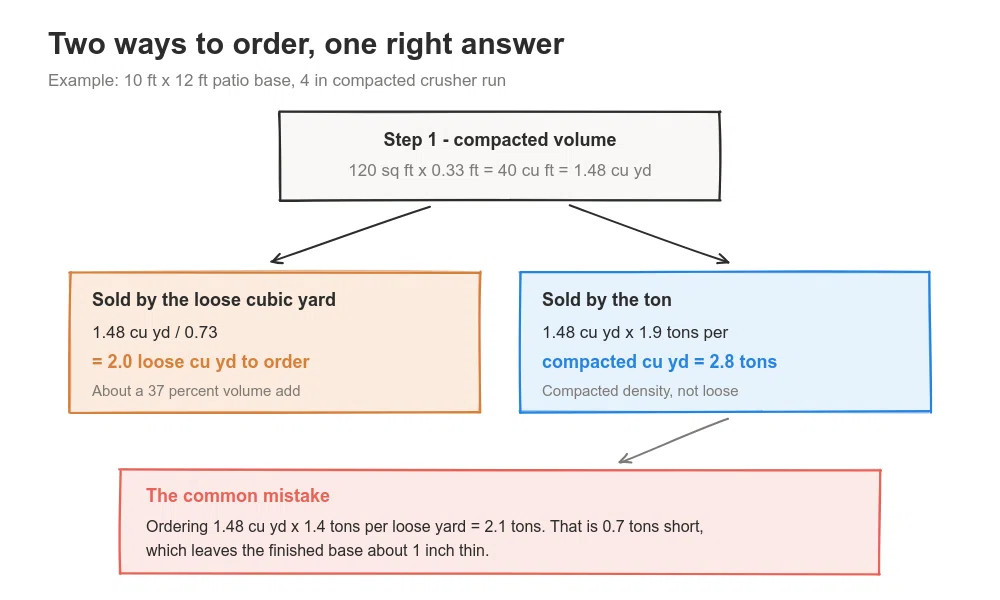
Paver patio: 10 ft × 12 ft, 4 in finished base
- Finished volume: 120 × 0.33 ft = 40 cu ft = 1.48 cu yd compacted
- Loose volume: 1.48 ÷ 0.73 = 2.0 loose cu yd
- Or by weight: 1.48 × 1.9 = 2.8 tons
- Bedding layer on top: 1 inch of screenings or coarse sand, screeded and not compacted before the pavers go down
What Still Settles After You Finish
Compaction loss and settlement are two separate things, and confusing them wastes money.
- Compaction loss happens under the plate, on the day. It is a volume conversion. You can predict it.
- Base densification under traffic is small if you hit density, and large if you compacted thick lifts or dry stone. This shows up as wheel-path ruts in the first season.
- Subgrade settlement is not a gravel problem at all. Stone pressed into a soft subgrade is stone you lost. Proof-roll first, dig out soft spots, and use a geotextile separation fabric over clay so the fines do not pump up into the base.
Agency work on aggregate base specifications keeps pointing at the same variables: gradation, fines content and field density control decide long-term performance, not the depth you spread. (NCDOT / NC State, Re-appraisal of the Specification for Aggregate Base Course) (NCHRP Report 172, Density Standards for Field Compaction of Granular Bases and Subbases)
Frequently Asked Questions (FAQs)
What is the compaction rate of gravel?
For dense-graded gravel such as crusher run, it is about 20 to 30 percent of the loose depth, so a compaction factor near 0.73. Open-graded stone such as #57 loses only about 8 percent because it has no fines to move into the voids.
How much crusher run do I need for a 4-inch base?
Spread about 5.5 inches loose. In volume terms, order your finished cubic yards ÷ 0.73, or about 1.37 times the finished volume.
Does gravel settle after it is compacted?
Properly compacted dense-graded base settles very little on its own. Later settlement almost always comes from one of three things: lifts that were too thick to compact through, material that was too dry, or a soft subgrade that was never proof-rolled.
Do I add compaction loss on top of a 10 percent waste factor?
Yes. They cover different losses. Compaction loss is a conversion between loose and compacted volume. Waste covers spillage, over-dig and low spots.
Is a plate compactor enough, or do I need a roller?
A plate is enough for patios, walkways and short driveways if you keep each finished lift at 4 inches or less. For lifts thicker than that, or long driveways, a vibratory roller is the right tool because plate energy does not reach the bottom of a thick lift.
How much does #57 stone compact?
About 8 percent, or roughly one inch of drop in a typical layer. It has almost no fines, so it locks by stone-to-stone contact instead of by density gain.
Should I compact the bedding sand under pavers?
No. Compact the base, screed the 1-inch bedding layer, set the pavers, then compact the pavers into the bedding layer.
Does crusher run need to be wet before compacting?
Damp, not wet. Dense-graded base reaches its highest density near 6 to 9 percent moisture. A handful should hold its shape with no free water.

About the Author
Qazi Raza – Technical Creator & Researcher
Qazi Raza develops construction, engineering, and home‑improvement calculators by researching verified formulas, industry standards, and authoritative reference materials. His tools are built using data from ASTM specifications, ASHRAE guidelines, NEC tables, building codes, and widely accepted engineering textbooks. Each calculator is designed to help homeowners, DIYers, and contractors make accurate, confidence‑based decisions.