
How to Calculate Board Feet for Irregular & Live Edge Slabs
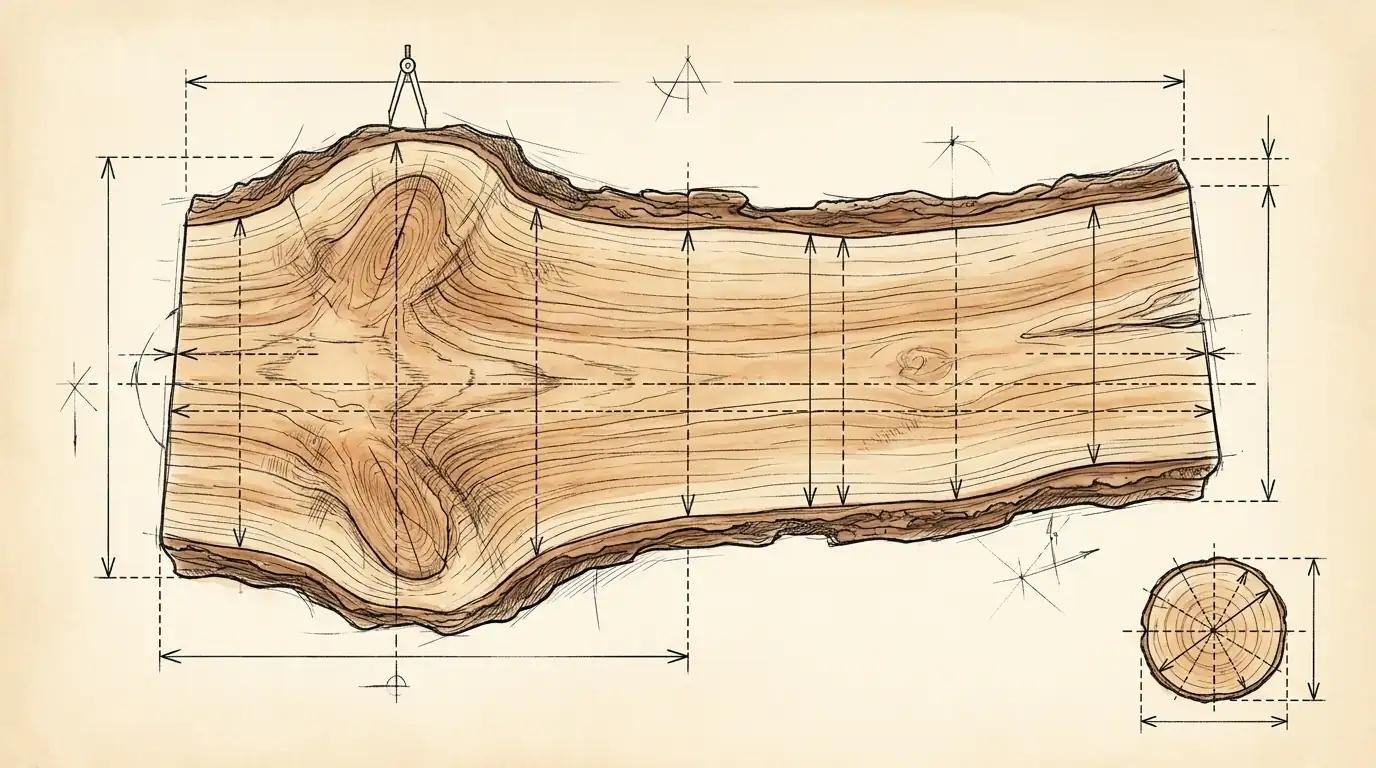
To calculate board feet for irregular and live edge slabs, measure the length, thickness, and three to five widths along the board in inches. Add the widths together and divide by the number of measurements to get your average width. Multiply the average width by the length and thickness, then divide the total by 144. Always measure from the narrowest face inside the bark.
The Core Formula for Live Edge Slabs
Standard dimensional lumber uses a basic volume equation. Live edge slabs require one modification to that equation: replacing fixed width with Average Width. Keep all measurements in inches to prevent decimal conversion errors across large slabs:
Board Feet = Thickness (in) x Average Width (in) x Length (in) / 144
One board foot equals 144 cubic inches of wood (12 in × 12 in × 1 in). If your sawmill measures length in whole feet instead of inches, divide the total by 12 instead of 144.
4 Calculation Methods by Slab Shape
Different tree geometries require specific measurement approaches. Using a basic three-point average on a heavily flared crotch slab or a round crosscut cookie will give you the wrong volume and cost you money.
| Slab Geometry | Best Measurement Method | Accuracy Level | Best Used For |
|---|---|---|---|
| Tapered / Wavy Edge | Multi-Point Width Average | Standard (±5%) | Dining tables, countertops, benches |
| Crotch / Flared Base | Trapezoidal Sectioning | High (±2%) | Y-shaped slabs, root flares, steep tapers |
| Burls / Freeform | 6-Inch Grid Mapping | Exact (±1%) | Irregular burls, asymmetrical coffee tables |
| Round Cookies | Circular Radius Formula | High (±2%) | End-grain crosscuts, tree rounds |
The Multi-Point Average Method (Standard Wavy Edges)
Use this method for typical flitches where the edges curve gently along the trunk.
- Measure Length: Run your tape along the center pith from end to end. Subtract any end splits (checks) that you plan to trim off.
- Take 5 Width Measurements: Measure across the face of the slab every 18 to 24 inches. Do not pick the widest spots or the narrowest spots, space your tape at equal intervals.
- Calculate Average Width: Add all five widths together and divide by 5.
- Run the Formula: Multiply your average width by the length and thickness, then divide by 144.
Example: A 96-inch walnut slab is 2.5 inches thick. Its five width measurements are 24″, 30″, 22″, 36″, and 28″.
Average Width: (24 + 30 + 22 + 36 + 28) / 5 = 28 inches
Calculation: (2.5 x 28 x 96) / 144 = 46.67 Board Feet
The Trapezoidal Sectioning Method (Crotch & Flared Slabs)
When a tree trunk splits into two branches (a crotch figure) or flares out at the root buttress, the width jumps suddenly. A basic average will skew the volume too high. Break the slab into separate trapezoids along its length:
- Mark lines across the slab where the shape changes sharply (for example, dividing a 96-inch slab into three lengths of 30″, 40″, and 26″).
- Measure the width at the top and bottom of Section 1 (e.g., 20″ and 32″). Add them and divide by 2 to get 26″. Multiply by length (30″) and thickness (2″), then divide by 144 = 10.83 BF.
- Repeat for Section 2 (32″ and 18″ widths = 25″ average; 40″ length; 2″ thickness) = 13.89 BF.
- Repeat for Section 3 (18″ and 42″ widths = 30″ average; 26″ length; 2″ thickness) = 10.83 BF.
- Add the sections together: (10.83 + 13.89 + 10.83 = 35.55 Board Feet
The Grid Mapping Method (Burls & Freeform Slabs)
Burl slabs have jagged spurs, deep coves, and no clear length or width axis.
- Snap a chalk grid of 6-inch by 6-inch squares over the slab, or lay a clear plastic sheet marked with a grid over the wood.
- Count every square that sits completely over solid wood.
- Count squares that are at least half full of wood as 0.5 squares. Ignore squares with less than half wood.
- Multiply your total number of squares by 36 (since each 6″ × 6″ square equals 36 square inches) to get the total surface area.
- Multiply total surface area by the slab thickness in inches, then divide by 144.
Also Read: Rough Sawn vs. Milled Thickness (S2S, S4S & The Quarter System)
The Circular Radius Method (Round Tree Cookies)
Crosscut tree rounds (cookies) are circular or oval. Applying the standard rectangular formula overestimates their volume by 21.5%.
- Measure the widest diameter across the center inside the bark (e.g., 42 inches).
- Measure the narrowest diameter perpendicular to your first line (e.g., 38 inches).
- Add both diameters and divide by 2 to get the average diameter (40 inches), then divide by 2 again to get the Radius (20 inches).
- Calculate the surface area using pi x r^2: 3.1416 x (20 x 20) = 1,256.64 sq in
- Multiply by the thickness (e.g., 3 inches) and divide by 144: (1,256.64 x 3) / 144 = 26.18 Board Feet.
Strict Rules for Bark, Wane, and Beveled Edges
Where you hook your tape measure changes the board footage by 10% to 25%. Under standard commercial grading rules outlined in the NHLA Hardwood Measurement Guidelines, bark and wane are excluded from clear cutting yields. For live edge slabs, buyers and sawyers use specific measurement points.
- Never Include the Bark: Bark falls off during kiln drying or gets chiseled away before finishing. Measure from the solid sapwood line (the cambium layer) on one edge to the solid sapwood line on the opposite edge. If a sawmill measures “outside bark to outside bark,” a 2-inch bark layer on each side of an 8-foot slab forces you to pay for 5.33 board feet of waste.
- Account for the Wane Bevel (Narrowest Face Rule): Because logs are round, slabs cut above or below the center pith have angled edges (wane). A slab might measure 36 inches wide on the bottom face, but only 30 inches wide on the top face.
- Buyer’s Rule: Measure the narrowest face if you need a guaranteed minimum table width.
- Fair Trade Rule: Measure the top face width and bottom face width at the same spot, add them together, and divide by 2. This gives the exact geometric volume of the beveled edge.
Deductions for Voids, Rot, and Epoxy River Pours
Old-growth slabs often contain hollow centers, ant cavities, or punky (rotted) heartwood. You should not pay hardwood prices for air, and you need to know the exact void volume to buy the right amount of casting resin.
- Calculate Gross Slab Volume: Measure the slab using the Multi-Point Average method as if the wood were completely solid.
- Calculate the Void Volume: Measure the average length and average width of the hollow cavity or rot pocket. Multiply Void Length × Void Width × Slab Thickness, then divide by 144.
- Subtract the Void: Subtract the void board footage from the gross board footage to get your Net Wood Board Feet.
Bonus Tip for Epoxy Workers: One board foot of void space equals 144 cubic inches, which takes 0.623 US gallons (2.36 liters) of liquid epoxy resin to fill completely. Simply multiply your void’s board footage by 0.65 (includes a 4% waste margin for wood absorption) to know exactly how many gallons of deep-pour epoxy to order.
Hidden Volume Loss: Drying Shrinkage & Router Flattening
Paying for gross board footage at a sawmill does not equal the net board footage you will have in your workshop. Two physical factors reduce usable slab volume: cellular shrinkage and mechanical flattening.
Green vs. Kiln-Dried Shrinkage Loss
If you buy a freshly milled (“green”) slab, the wood cells hold both free water and bound water. Once a slab dries below the fiber saturation point (around 30% moisture content), the cell walls shrink. Data from the USDA Forest Products Laboratory Wood Handbook shows that North American hardwoods lose 7% to 16% of their total volume when drying from green condition to oven-dry condition.
Furthermore, an Oregon State University Wood Shrinkage Study confirms that flat-sawn boards shrink along their width (tangential direction) nearly twice as much as their thickness (radial direction). When buying a green live edge slab to air-dry yourself, expect a 6% to 10% drop in actual board footage by the time the wood reaches 8% indoor equilibrium moisture content.
Cup, Twist, and Router Sled Loss
Wide slabs almost always cup or twist as internal growth stresses release during drying. According to a Purdue University Extension Furniture Shrinkage Paper, seasonal and drying moisture shifts cause uneven dimensional distortion across wide tangential grain.
When you flatten a cupped 12/4 (3-inch thick) slab with a router sled or CNC machine, you have to mill down the high corners on both faces until the board is flat.
- A slab with 0.25 inches of cup requires removing 0.25 inches from the top and 0.25 inches from the bottom.
- Your 3-inch slab drops to 2.5 inches net thickness, an immediate 16.6% loss in usable board feet. Always check a slab with winding sticks before buying to see how much thickness you will lose on the flattening table.
Why Log Scaling Rules Fail on Individual Slabs
Many novice woodworkers try to use forestry log scales, such as the Doyle, Scribner, or International 1/4-Inch rules, to price individual slabs. As documented in the Purdue Extension Log Scaling Guide, log rules estimate how many rectangular 1-inch boards a whole cylindrical log will yield before sawing, automatically deducting 4 inches or more for sawdust kerf and outer slab edging.
Once a log is sawn into live edge flitches (boules), log scaling formulas become useless. Sawmills Keep the outer wane intact on live edge slabs instead of edging it off into scrap, meaning the actual board footage of a live edge boule is 15% to 30% higher than what the Doyle log scale predicts. Always measure each cut slab individually.
Frequently Asked Questions (FAQs)
Does planing or sanding a slab reduce its billable board footage?
No. In the lumber industry, board footage is calculated based on the rough-sawn nominal thickness before surfacing. If a sawmill flattens a 2-inch rough slab down to 1.75 inches for you on their CNC, you still pay for the full 2-inch starting volume.
How do I convert slab board feet to cubic meters or liters?
To convert board feet into metric units, divide your total board feet by 423.776 to get cubic meters (m^3). To convert board feet into liters, multiply your board feet by 2.3597.
Should I include sapwood when measuring slab width?
Yes, as long as the sapwood is solid and free of soft rot (spalting decay). Unlike traditional cabinetmaking where walnut or cherry sapwood is ripped off as waste, live edge woodworking keeps the pale sapwood ribbon to preserve the natural outer profile of the tree.
How do I calculate the weight of a live edge slab from its board footage?
Divide your slab’s total board footage by 12 to convert the volume into cubic feet. Next, multiply the cubic feet by the species weight per cubic foot at its current moisture content (for example, kiln-dried Black Walnut weighs roughly 38 lbs per cubic foot; a 48 BF slab equals 4 cubic feet, weighing 152 lbs).
Why do sawmills charge more per board foot for slabs over 36 inches wide?
Sawmills use tiered board foot pricing based on width and thickness. A tree large enough to yield a 40-inch wide slab takes 80 to 150 years to grow, requires specialized wide-head bandsaw mills, and takes two to three years to air-dry before kiln drying. While standard 8-inch walnut lumber might cost $10 per board foot, a 40-inch walnut slab often sells for $25 to $45 per board foot.
Technical Basis
All volume calculations rely on standard solid geometry (1 board foot = 144 cubic inches) and National Hardwood Lumber Association (NHLA) grading principles. Shrinkage, moisture loss, and distortion rates reflect empirical wood physics data from the USDA Forest Products Laboratory.
Disclaimer
This article provides wood measurement formulas for educational and estimating purposes only. Custom sawmills and hardwood dealers use independent scaling policies regarding bark, wane, and defects. Always confirm exact measurement terms with your lumber supplier before finalizing any slab purchase.

About the Author
Qazi Raza – Technical Creator & Researcher
Qazi Raza develops construction, engineering, and home‑improvement calculators by researching verified formulas, industry standards, and authoritative reference materials. His tools are built using data from ASTM specifications, ASHRAE guidelines, NEC tables, building codes, and widely accepted engineering textbooks. Each calculator is designed to help homeowners, DIYers, and contractors make accurate, confidence‑based decisions.