
How to Read Lumber Stamps: Grading, Moisture, and Species Marks
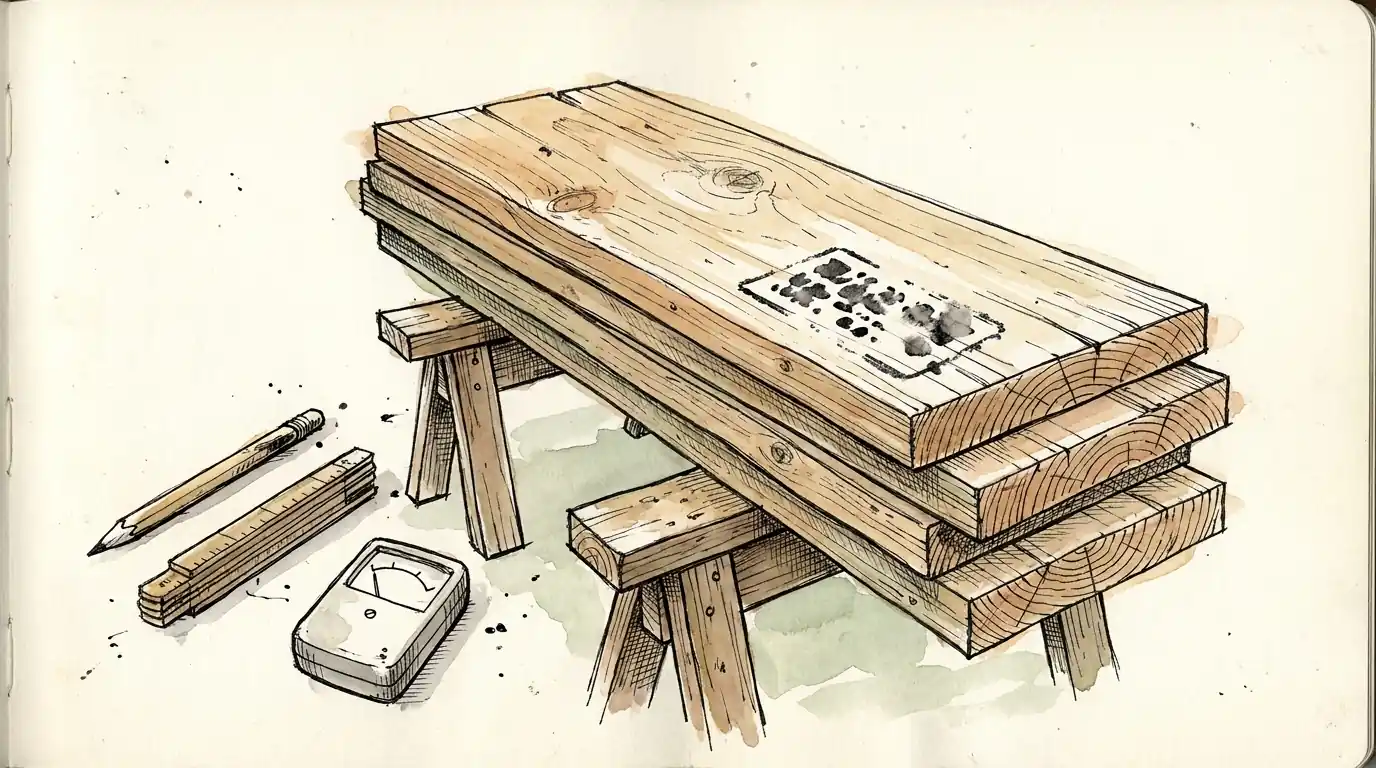
Every stick of dimensional softwood at the lumber yard carries a small inked block on its wide face. It looks like a random pile of letters and numbers: S-DRY, KD-HT, SPIB No.2, STUD, a mill number, and a logo you have never seen before. Most shoppers walk right past it and pick boards by eye instead.
That little block is the most useful label in the whole store. It tells you how wet the board is, how strong it is, what tree it came from, and who inspected it. Read it wrong and you can end up with soaking wet framing that shrinks a quarter inch after your drywall goes up, or a wall stud rated only for light duty holding up a beam.
What is a Lumber Stamp?
A grade stamp is a quality certificate printed straight onto the board. In the United States, it comes from the American Softwood Lumber Standard (PS 20), which is run by the American Lumber Standard Committee. The committee accredits the grading agencies, and those agencies send inspectors to member mills through the year to keep the marks honest.
Building codes in the U.S. and Canada expect framing lumber to be graded and stamped. Your inspector may check for it. Your engineer relies on it, because published design values, the numbers used to size a joist or header, are tied to a specific species group and grade combination. Without the stamp, the board is just wood with no paperwork.
A compliant stamp carries five pieces of information:
- The grading agency that certifies the mill
- The mill number or mill name
- The grade
- The species or species group
- The moisture condition at the time the board was surfaced
That is it. Once you know the five slots, no stamp looks scary again.
The 5-Second Stamp Scan
Graders do not read the stamp left to right. They hunt for the two facts that matter most for the job in hand. Do the same and you can clear a whole bunk of lumber quickly.
- Find the moisture code first. S-GRN, S-DRY, KD, KD-HT, KD19, MC15, or KD15. This decides whether the board will move after installation.
- Find the grade second. Select Structural, No.1, No.2, No.3, STUD, CONST, STAND, or UTIL. This decides whether the board can carry load.
- Find the species group third. SPF, HF or HEM-FIR, DF-L, SYP. This decides how strong that grade actually is.
- Glance at the agency and mill last. WWPA, SPIB, NELMA, WCLIB, NLGA, PLIB, RIS. This is your proof the first three are real.
If you remember nothing else: moisture, grade, species, agency.
Moisture Marks: S-DRY vs KD Lumber and the Rest
Moisture is where homeowners lose the most money, because wet wood does not stay the same size. Wood shrinks as it dries below the fiber saturation point, which sits near 28 percent moisture content, and most of the movement happens between about 28 percent and 19 percent.
Research from the USDA Forest Products Laboratory shows the relationship between moisture content and shrinkage is measurable and predictable for the softwood species used in framing.
Here is what the codes mean.
| Stamp code | Full name | Maximum moisture content | What it means for you |
|---|---|---|---|
| S-GRN | Surfaced green | Above 19 percent | Unseasoned. Cheapest. Will shrink and can twist in place. |
| S-DRY | Surfaced dry | 19 percent or less | Dried before surfacing, often air dried. Standard framing stock. |
| KD or KD19 | Kiln dried | 19 percent or less | Dried in a controlled kiln. More consistent than air dried. |
| KD-HT | Kiln dried, heat treated | 19 percent or less | Kiln dried plus heated to kill insects and pathogens. |
| HT | Heat treated | Not a dryness claim | Pest treatment only. Common on export and pallet stock. |
| MC15 or KD15 | Moisture content 15 | 15 percent or less | Driest common option. Best dimensional stability. |
So what is the real difference between S-DRY and KD?
This is the question that trips up almost everyone, and the honest answer is refreshing: on paper, very little. Both S-DRY and KD certify 19 percent moisture content or less at the moment the board was surfaced. Neither one promises 12 percent. Neither one promises the board is still that dry today.
The difference is the method and the consistency:
- S-DRY only tells you the board hit 19 percent or below by some approved method, which is often air drying in a yard.
- KD tells you a kiln did the work under controlled heat and humidity, so the drying tends to be more even through the thickness and the batch tends to be more uniform.
- MC15 and KD15 are the only marks that promise a genuinely drier board.
Moisture gradients are the reason kiln drying matters. Wood can be dry on the surface and still wet in the core, and the shrinkage curve under a moisture gradient is not a straight line. A board that reads 15 percent on a surface meter can hold a wet center that keeps releasing moisture for weeks, which is how a straight stud turns into a bowed one after it is nailed in.
The shrinkage math
A useful field rule for framing softwoods: expect roughly 1 percent of dimensional change across the width for every 4 percentage points of moisture content change. Interior framing in a heated home usually settles near 8 to 10 percent, not 19 percent. So even a legal S-DRY board still has drying left to do.
| Board | Actual width | Drying from 19% to 9% | Approximate shrink |
|---|---|---|---|
| 2×4 | 3.5 in | 10 points | About 3/32 in |
| 2×6 | 5.5 in | 10 points | About 1/8 in |
| 2×10 | 9.25 in | 10 points | About 7/32 in |
| 2×12 | 11.25 in | 10 points | About 9/32 in |
One board moving 1/8 inch is nothing. Now stack it. Three floor joists plus a rim plus double top plates in a two story wall, and you are looking at a cumulative drop of half an inch or more in the frame. That is the source of nail pops, drywall cracks over doors, squeaky floors, and tile grout lines that open in year one.
Multi-story wood framing designers plan for this shrinkage on purpose, and reviews of wood drying behavior confirm that shrinkage varies with drying conditions, thickness, and anatomy rather than being one fixed number per species.
A practical decision rule:
- New framing on an open site: S-GRN or S-DRY is fine, because everything dries together at a similar pace.
- Patching into an existing heated house: pay for KD, and MC15 if you can find it. The old framing is already dry, so a wet new board is the only piece that will move.
- Shelving, built-ins, closet cases, trim backing: MC15 or KD15, always. This is where movement shows.
Grade Marks: What the Numbers and Words Mean
The grade describes strength-reducing characteristics such as knot size and location, slope of grain, wane, splits, and shake. Lower number means fewer and smaller defects, which means higher published design values. Visual grading and the design properties that come from it are documented in USDA Forest Service work on stress grades and lumber design properties.
Structural light framing and joists and planks
| Grade on the stamp | Reads as | Typical use |
|---|---|---|
| SEL STR or SS | Select Structural | Highest visual grade. Long spans, engineered members. |
| No.1 or #1 | Number 1 | Strong framing where design values are tight. |
| No.2 or #2 | Number 2 | The workhorse. Most joists, rafters, beams, and plates. |
| No.3 or #3 | Number 3 | Low load duty. Blocking, bracing, non-structural work. |
Light framing and stud grade
| Grade on the stamp | Reads as | Typical use |
|---|---|---|
| CONST | Construction | General framing, plates, sills, blocking. |
| STAND | Standard | Lower duty framing and blocking. |
| UTIL | Utility | Temporary work, furring, crating. |
| STUD | Stud grade | Vertical use in load bearing walls, straightness controlled. |
| ECON or ECON STUD | Economy | Temporary only. Not for permanent structure. |
The STUD grade trap
STUD grade is not a weak grade. It is a specialized grade, sorted for pieces that stay straight and perform well in compression as a vertical member in a wall. That is exactly what a stud does.
What it is not sorted for is bending across a span. Grabbing STUD grade 2x8s because they were on sale and using them as floor joists or as a header is the classic mistake. If a board will be loaded across its length, you want No.2 or better in the joists and planks category. If it will stand upright in a wall, STUD is doing its job.
Also worth knowing: some yards sell bundled grade mixes such as “No.2 and Better” or “Standard and Better.” Each piece is still stamped individually, but the whole bundle has to be designed to the lowest grade in it. So read individual boards, not the bundle tag.
Species Marks: SPF, Hem-Fir, DF-L, and SYP
All framing species get graded on the same ladder, but they are not equally strong. A No.2 in one species group can be noticeably stronger than a No.2 in another, so the species mark is not trivia. It is half of the strength answer.
| Stamp mark | Species group | Where it comes from | Character |
|---|---|---|---|
| DF-L, D FIR, DOUG FIR | Douglas Fir and Western Larch | Western U.S. | High strength and stiffness. Holds fasteners well. |
| SYP or S PINE | Southern Yellow Pine | Southeast U.S. | Very strong and dense. Takes treatment well. Can be prone to movement. |
| HF or HEM-FIR | Western Hemlock and true firs | Western U.S. | Mid range strength. Light color, clean, planes nicely. |
| SPF | Spruce, Pine, Fir | Canada, graded to NLGA rules | Light, straight, small knots. Very common in big box stores. |
| SPF-S or SPF(S) | Spruce, Pine, Fir South | U.S. grown | Different design values from Canadian SPF. Not interchangeable. |
| PP, IWP, ES, LP | Ponderosa Pine, Idaho White Pine, Engelmann Spruce, Lodgepole Pine | Western U.S. | Single species marks, usually appearance and light framing. |
| DF-L(N), HF(N) | Canadian grown equivalents | Canada | Separate grade marks and separate design values. |
Why species groups even exist
Mills do not sort every log by exact species. Trees that grow together and behave similarly get grouped, then the whole group is assigned design values based on the weakest member of the group. That is why you see combination marks instead of single tree names. It is a conservative system that works, as long as you do not mix groups by accident.
The practical part: the (N) and (S) tags matter. SPF and SPF-S are not the same product on paper, and DF-L is not DF-L(N). If a plan specifies a species group and grade, substituting a different group can quietly change your span capacity even though the grade number looks identical.
Simple substitution habit
If your plan or span table says one thing and the yard has another, sort by this order of stiffness and strength for typical framing sizes: DF-L and SYP at the top, Hem-Fir in the middle, SPF below that. Moving up the list is usually safe. Moving down the list is a change that needs a span table check or an engineer, not a guess.
Agency and Mill Marks: Your Proof It Is Real
The agency logo is the smallest part of the stamp and the part that makes the rest trustworthy. Common marks you will see:
- WWPA or WWP, Western Wood Products Association
- SPIB, Southern Pine Inspection Bureau
- NELMA, Northeastern Lumber Manufacturers Association
- WCLIB, West Coast Lumber Inspection Bureau
- PLIB, Pacific Lumber Inspection Bureau
- NLGA, National Lumber Grades Authority, Canada
- RIS, Redwood Inspection Service
- NSLB, Northern Softwood Lumber Bureau
The mill number or name sits next to it. That number is traceability. If a bunk of lumber turns out to be badly graded, the agency can trace it back to the mill that stamped it.
Red flags on a stamp
Counterfeit and sloppy stamps do exist, and inspectors have found homemade stamp sets. Be suspicious when you see:
- No agency logo at all, just a grade and a species
- A blurry, smeared, or hand-stenciled block that does not look machine printed
- A grade word that is not in any published category, such as “Premium Structural”
- A species abbreviation that does not match any recognized group
- Stamps only on the ends of boards where they get cut off, with nothing on the face
- A structural claim on lumber that is clearly export or crating stock marked only HT
One more note that surprises people: cross cutting graded lumber is completely normal in framing. A grader stamps the piece once, and the crew cuts it into shorter pieces. Once you cut off the stamped section, that piece has no mark. It is still the same lumber, but an inspector cannot verify it. Keep one stamped offcut from each bunk in a corner of the site so you can prove what you used.
Reading Three Real Stamps, Start to Finish
Example 1: WWPA 12 STUD S-DRY HEM-FIR
Western Wood Products Association certifies mill 12. The board is Stud grade, dried to 19 percent or less before surfacing, and it is Hem-Fir. Verdict: a good, honest wall stud for a load bearing wall. Do not lay it across a span as a joist.
Example 2: SPIB No.2 KD-HT S PINE
Southern Pine Inspection Bureau. Number 2 grade, kiln dried to 19 percent or less, and heat treated. Southern Yellow Pine. Verdict: strong, stable enough for framing next to existing dry structure, and the HT mark means insects and pathogens were cooked out. Good pick for joists and rafters within span limits.
Example 3: NLGA No.2 S-GRN SPF
Canadian grading authority, Number 2 grade, surfaced green above 19 percent moisture, Spruce-Pine-Fir. Verdict: fine and economical for a whole new frame that will dry as a unit. A poor choice for a closet built-in or for sistering onto twenty-year-old dry joists, because it is the only wet piece in the assembly.
Buying Checklist for the Yard
Use this in order, right at the stack.
- Know your quantity before you go, so you are not doing math in the aisle. Run your board feet through a lumber calculator first.
- Confirm the actual size you need, since a 2×4 is not 2 inches by 4 inches. Check nominal vs actual lumber sizing before you cut your list.
- Read the moisture code. Match it to whether the board goes into a dry, heated space or an open new frame.
- Read the grade. STUD for walls, No.2 or better for spans, No.3 for blocking.
- Read the species group. Confirm it matches your span table or plan, including any (N) or (S) tag.
- Confirm an agency logo and a mill mark are both present.
- Sight down the narrow edge of each board for crook and bow, and look at the end grain. Reject boards with the pith center running through them, since those move the most.
- Check for a wet feel, dark staining, or a heavy board in a light species. Weight is a decent moisture clue.
- Buy 10 to 15 percent extra so you can cull the worst pieces instead of using them.
The two dollar tool that settles arguments
A basic pin or pinless moisture meter is the single best upgrade to your lumber buying. The stamp records moisture at the mill on the day of surfacing. It says nothing about the three weeks the bunk sat outside in the rain behind the store.
Spot check a few boards. If your KD stamped 2×6 reads 22 percent on the meter, the stamp is not lying, the storage is. Buy it anyway if you need it, but sticker it and let it acclimate.
How to acclimate lumber the right way
- Stack boards flat with 3/4 inch stickers between every layer so air reaches all four faces.
- Keep the stack off the concrete floor, since slabs give off moisture.
- Let it sit in the space where it will be installed, not the garage, for 5 to 14 days.
- Weight the top of the stack so drying boards cannot cup as they release moisture.
- Re-check with the meter before you cut. Studies of wood shrinkage at both the board and cell level show that movement follows moisture change closely, so a stable meter reading is your green light.
The Takeaway
The stamp is a five part label, and you only really need three of the parts to shop well. Moisture tells you how much the board will move. Grade tells you how much it can carry. Species tells you how much that grade is actually worth.
Start at the moisture code, work through grade and species, glance at the agency to confirm it is legitimate, then verify with a meter and a straight sighting down the edge. That routine takes about five seconds a board once it becomes habit, and it is the difference between a frame that stays quiet and one that cracks, squeaks, and pops for the next two winters.
Frequently Asked Questions (FAQs)
Is kiln dried lumber always better than S-DRY?
Not always, and not by definition. Both certify 19 percent or less. Kiln dried is usually more uniform and a safer bet for interior work, and it is worth the upcharge when you are joining to dry existing framing. For a full new frame drying together, S-DRY is fine.
Does the stamp tell me the moisture content today?
No. It records the condition when the board was surfaced at the mill. Storage, weather, and time change it. Use a meter for today’s number.
What if the board has no stamp?
For structural work, do not use it, and expect an inspector to flag it. Unstamped lumber has no verified grade, species, or moisture condition, so no design values apply to it. Unstamped pieces are fine for non-structural shop work and jigs.
Can I use STUD grade for a header or a joist?
No. Stud grade is sorted for vertical use in walls. Bending members need No.2 or better in the appropriate grade category, sized with a span table for the exact species group and grade.
What does HT mean if it is on its own?
Heat treated for pest control, commonly required for export packaging. On its own it is not a dryness claim and not a structural grade. Kiln dried lumber may also carry HT, written as KD-HT or KD19 HT.
Which is stronger, SPF or Hem-Fir?
For typical framing sizes, Hem-Fir generally carries higher design values than SPF, and DF-L and Southern Yellow Pine generally sit above both. Always confirm with a span table for the exact grade, size, and spacing rather than substituting on feel.
Technical Basis
Stamp elements, moisture codes, and grade categories follow the American Softwood Lumber Standard PS 20 and the National Grading Rule, as administered by the American Lumber Standard Committee and accredited agencies including WWPA, SPIB, NELMA, WCLIB, PLIB, and NLGA. Shrinkage figures and drying behavior draw on USDA Forest Products Laboratory research and peer reviewed wood science literature.
Disclaimer
This guide is general educational information, not engineering advice. Grade stamp formats, agency marks, and design values change over time and vary by region and mill. Always confirm species group, grade, and span requirements with current published span tables, your local building code official, or a licensed engineer before buying or installing structural lumber.

About the Author
Qazi Raza – Technical Creator & Researcher
Qazi Raza develops construction, engineering, and home‑improvement calculators by researching verified formulas, industry standards, and authoritative reference materials. His tools are built using data from ASTM specifications, ASHRAE guidelines, NEC tables, building codes, and widely accepted engineering textbooks. Each calculator is designed to help homeowners, DIYers, and contractors make accurate, confidence‑based decisions.